
Forgiveness & Redemption
Bible Verses About Second Chances: For the Person Who Thinks They’ve Gone Too Far
The Bible is full of second chances. Peter denied Jesus three times and became the rock of the church. Jonah ran from God and still delivered the message. These verses prove that your worst day doesn’t have to be your last chapter.
My parents wrote a check to Teen Challenge.
They didn’t have the money. It was the last couple hundred dollars they had. But their kid had burned through every chance they’d given him, had robbed an apartment above a church, had left the program after four days the first time around, and they still sat down and wrote that check.
It never got cashed. But they wrote it anyway.
I’ve thought about that check a lot over the years. Not just what it cost them, but what it meant. It meant they still believed something was possible. It meant they were putting their last dollars behind a kid who had given them exactly zero reasons to.
If you’re reading this because you think you’ve gone too far -because the thing you did is too big or you’ve relapsed too many times or you’ve burned every bridge that mattered -I want to start there. With that check. Because that’s what grace looks like in the physical world. Someone who has every reason to close the book on you, and they don’t. They reach in their pocket and they put something on the line.
God’s been doing that since the beginning.
The Bible isn’t a book about people who got it right. It’s a book about people who got it spectacularly wrong, and what God did with them anyway. That’s not a feel-good spin. That’s the actual story. From Genesis to Revelation, the people God uses most are the ones who had the most to be forgiven.
If your life has been a disaster, you’re in excellent company.
TL;DR
The Bible is full of second chances. Peter denied Jesus three times and became the rock of the church. Jonah ran from God and still delivered the message. These verses -and the real people who needed them -prove that your worst day doesn’t have to be your last chapter.
Watch: Justin's Story
The Lie That Won’t Quit
When You Think You’ve Gone Too Far
This is the lie. Not one of several lies. The lie. The one the enemy doesn’t stop whispering because it works.
“You’ve done too much. You’ve gone too far. There’s a line, and you crossed it.”
Here’s what the Bible actually says:
Psalm 103:12
“As far as the east is from the west, so far has he removed our transgressions from us.”
East and west never meet. That’s not poetry being dramatic. That’s a statement about infinity. There’s no point on a compass where east becomes west. God chose that image on purpose. Whatever you did, He put it further away than that.
Isaiah 1:18
“Come now, let us settle the matter, says the Lord. Though your sins are like scarlet, they shall be as white as snow; though they are red as crimson, they shall be like wool.”
Scarlet was the color that didn’t come out. In the ancient world, if something was dyed scarlet, it stayed scarlet. Isaiah’s audience knew what he was saying. The stain that doesn’t wash out. And God said, bring it here anyway.
Romans 8:1
“Therefore, there is now no condemnation for those who are in Christ Jesus.”
No. Not less. Not most of the time. No condemnation. That verse is doing a lot of heavy lifting for a lot of people walking around convinced God is done with them.
1 John 1:9
“If we confess our sins, he is faithful and just and will forgive us our sins and purify us from all unrighteousness.”
Notice what that verse doesn’t say. It doesn’t say “most sins.” It doesn’t have a footnote. There’s no asterisk leading to a list of exceptions. All.
Micah 7:18–19
“Who is a God like you, who pardons sin and forgives the transgression of the remnant of his inheritance? You do not stay angry forever but delight to show mercy. You will again have compassion on us; you will tread our sins underfoot and hurl all our iniquities into the depths of the sea.”
He hurls it. Not sets it aside. Not files it away. Hurls it into the sea. The prophet Micah had seen a lot of failure -personal and national -and this is still what he believed about God. That image should do something to the way you’re carrying what you’re carrying. For more on what Scripture says about forgiveness, see our full guide on Bible Verses About Forgiveness.
Support the Work
Help Keep
the Door Open
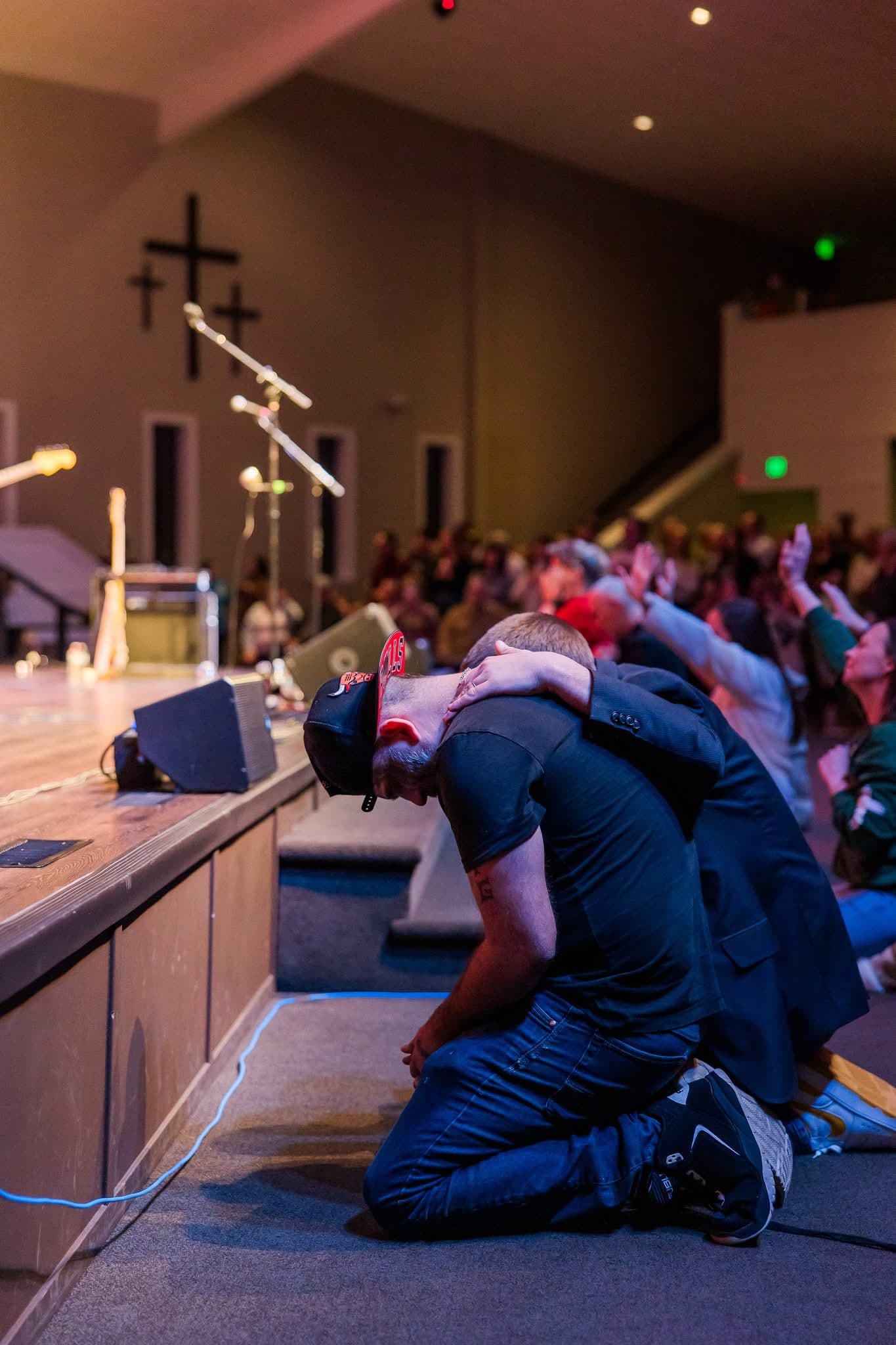
Recovery doesn't happen by accident. It takes people willing to fund the bed, the meal, the mentor, and the long road back.
Your gift provides Christ-centered recovery referrals, resources, and family support for people rebuilding their lives in the Shenandoah Valley. Be the reason the next one makes it.
For the Person Who’s Been Here Before
When You’ve Failed the Same Way Again
This section is for the person who’s been here before.
Not just in recovery. Maybe in a marriage you swore you’d fix. A pattern you thought you’d broken. A version of yourself you were sure you’d buried for good.
Relapse isn’t the end of the story. It’s the part of the story that almost convinced you it was.
Lamentations 3:22–23
“Because of the Lord's great love we are not consumed, for his compassions never fail. They are new every morning; great is your faithfulness.”
These are words Jeremiah wrote sitting in the ruins of Jerusalem. His city had been destroyed. His people were in exile. He had watched everything fall apart. And he looked at the morning and said: mercy is new. Again. That’s the verse that survives disaster.
Proverbs 24:16
“For though the righteous fall seven times, they rise again.”
Seven is not a literal number. It means indefinitely. It means the righteous person isn’t defined by how many times they fell. They’re defined by the rising.
Psalm 37:24
“Though he may stumble, he will not fall, for the Lord upholds him with his hand.”
I used to read that verse past. Now I think it’s one of the most honest things in the Psalms. It doesn’t say the righteous person won’t stumble. It says God’s hand is there when they do.
2 Corinthians 12:9
“But he said to me, 'My grace is sufficient for you, for my power is made perfect in weakness.'”
Paul asked God three times to remove whatever was tormenting him. God said no. And then God said the most counterintuitive thing you can say to someone who feels like their failure is holding them back: that weakness is where My power shows up clearest.
Jonathan sat in a jail cell and told himself he’d just do his time and go right back out. That lasted two months. He came to Teen Challenge, relapsed, came back, relapsed again. Every time, the same voice: you’ve done this too many times, it’s just not for you, why not go as hard as you can and destroy everything.
He described it as a state of condemnation where the logic of the enemy actually makes sense -you’ve already blown it, so why stop now? He came back anyway. The hard part wasn’t getting clean. The hard part was walking through the door believing it was still open for him.
Watch: Jonathan's Story
The Humans Who Needed These Verses
People in the Bible Who Got Second Chances
This is where every competitor’s article falls apart. They list verses. They don’t show you the humans who needed them.
Peter
Peter didn’t drift away from Jesus. He stood in a courtyard and denied, three separate times, that he even knew Him. Not once. Three times. To a servant girl, to a bystander, to someone standing nearby. The third time he denied it, the rooster crowed, and Jesus turned and looked right at him.
And then, after the resurrection, Jesus made breakfast on a beach and asked Peter three times: do you love me? Once for each denial. He didn’t lecture Peter. He reinstated him. “Feed my sheep.” The person who failed loudest became the foundation of the early church. (John 21:15–17)
Jonah
God gave Jonah a mission and Jonah booked a boat ticket going the exact opposite direction. He didn’t just hesitate. He ran. He ended up in the belly of a fish, which is not a metaphor, it’s where he actually spent three days. And then the word of the Lord came to Jonah a second time. (Jonah 3:1)The phrase “a second time” is doing everything. God didn’t replace Jonah with someone more obedient. He came back to the same person who had run.
David
David committed adultery and then arranged for the woman’s husband to be killed in battle to cover it up. That’s the summary. The long version is worse. And yet he’s called a man after God’s own heart, and Psalm 51 -his prayer of confession after the prophet Nathan confronted him -is still the most honest piece of writing about guilt and grace in Scripture. God didn’t erase David’s consequences. But He didn’t erase David either.
Paul
Before he was the man who wrote half the New Testament, Paul stood and watched approvingly while people stoned the first Christian martyr to death. He was the person hunting down followers of Jesus to have them imprisoned. He was, in his own words, the worst of sinners. (1 Timothy 1:15) He became the most prolific voice for the gospel in history. If that doesn’t challenge your theology of who God can use, I don’t know what will.
The Woman at the Well
Five husbands. Currently living with a man she wasn’t married to. Fetching water alone in the middle of the day because she couldn’t face the other women. Jesus sat down next to her and had the longest recorded personal conversation in the gospels. He didn’t start with her past. He started with a cup of water. She went back to her city and told everyone she met. She became one of the first evangelists. (John 4)
Rahab
She ran a brothel. She made a choice to protect the Israelite spies sent by Joshua, and that choice is what gets her in the record. What the genealogy in Matthew chapter 1 doesn’t explain is what makes it remarkable: Rahab is in the direct bloodline of Jesus. From a brothel in Jericho to the family tree of the Son of God. (Joshua 2, Matthew 1:5) You can’t tell me God doesn’t know how to write a second act.
Shame Wearing a Disguise
When Guilt Won’t Let You Accept the Second Chance
Here’s something that doesn’t get said enough.
A lot of people don’t need more convincing that God can forgive them. They know the verses. They’ve heard the sermons. The problem isn’t theological. The problem is that guilt has become so familiar that putting it down feels like losing something.
Guilt also masquerades as humility. Carrying it feels like taking responsibility. Letting it go feels dangerous, like you might repeat everything all over again if you stop punishing yourself.
That’s not humility. That’s the enemy making shame sound like a spiritual discipline.
Isaiah 43:18–19
“Forget the former things; do not dwell on the past. See, I am doing a new thing! Now it springs up; do you not perceive it?”
God doesn’t say forget the past so you can pretend it didn’t happen. He says forget it because He’s already doing something new, and you can’t see it while you’re turned the wrong direction.
Philippians 3:13–14
“But one thing I do: Forgetting what is behind and straining toward what is ahead, I press on toward the goal to win the prize for which God has called me heavenward in Christ Jesus.”
Paul wrote that from prison. He wasn’t forgetting his past because it was comfortable. He was straining toward something more important.
2 Corinthians 5:17
“Therefore, if anyone is in Christ, the new creation has come: The old has gone, the new is here!”
Not the old is being phased out. Not the old is mostly gone. The old has gone.
Joel 2:25
“I will repay you for the years the locusts have eaten.”
This one undoes people, and it should. God doesn’t just forgive. He restores. The years don’t just get forgiven and wasted. He says He will repay them. If you’ve lost years to addiction, to bad decisions, to a version of yourself you’re not proud of, that verse is not poetry. It’s a promise.
This verse also lands differently when grief is wrapped around the loss. If that’s where you are, what the Bible says about grief is worth reading alongside this.
Rob Reynolds knows what it’s like to be free on paper and still stuck. Guilt after addiction doesn’t always look like regret. Sometimes it looks like a theology -like carrying the weight of what you did is the least you owe. Like putting it down would be letting yourself off too easy.
That’s the trap. Here’s how he got out of it.
Watch: Rob's Story
Luke 15
The Most Dramatic Second Chance in the Bible
There’s a story Jesus told that I come back to more than almost anything else in the gospels.
A son goes to his father and essentially tells him he wishes he were dead, takes his inheritance early, and burns through every dollar of it in another country. He ends up working on a pig farm, starving, and the pigs are eating better than he is. He comes to his senses, works out a speech asking to come back not as a son but as a hired hand, and starts the long walk home.
The father sees him from a long way off. Not because he happened to glance out the window. Because he was watching. He ran to his son. He didn’t wait for the speech. He didn’t make him explain himself at the gate. He ran.
He threw a party. His other son, the responsible one who had stayed home and done everything right, stood outside and wouldn’t come in. And the father went out to him too.
Neither son fully understood the father.
The parable isn’t primarily about the son’s return. It’s about the kind of father that makes return possible.
The father gave the son three things when he came home: a robe, a ring, and sandals. Those weren’t random gifts. They map directly to identity, peace, and purpose — the three things addiction strips away and sobriety alone doesn’t restore. I unpack that framework in the Prodigal Son and addiction recovery.
I think about my dad when I read that story. Rev. John Franich Jr. built this ministry from nothing. He ran SVTC for years. He watched his own son go sideways and still found ways to stay in the fight for him, including writing a check with money he didn’t have. He passed away on Christmas morning 2025. I still carry that check in a way I can’t fully explain.
The prodigal son didn’t get a second chance because he’d earned it. He got one because his father was the kind of father who runs. If you’ve lost a father and the ache of that sits underneath everything else you’re reading here, there’s more on that specific grief.
When the Room Has Given Up
When No One Else Believes You Deserve Another Chance
Sometimes the hardest part isn’t convincing God. It’s everyone else.
Family members who’ve been hurt too many times. Friends who’ve stopped picking up. People who love you but have genuinely run out of capacity to hope on your behalf. You can’t always blame them.
But their capacity isn’t the ceiling. God’s is.
Ezekiel 37:1–6
“[The valley of dry bones] -'Can these bones live?'”
God asked Ezekiel a question so bizarre it almost sounds cruel: can these bones live? And then He told him to prophesy over them anyway. The bones didn’t show any signs of life before Ezekiel started speaking. He spoke anyway. This is one of the most defiant images in all of Scripture. God calling life out of what looks, by every available measure, completely dead.
Romans 8:31
“If God is for us, who can be against us?”
Not rhetorical. Actual. Whatever lineup of people has decided you’re not worth the investment, it’s a shorter list than the one on your side.
Isaiah 41:10
“So do not fear, for I am with you; do not be dismayed, for I am your God. I will strengthen you and help you; I will uphold you with my righteous right hand.”
When no one in the room believes you can change, and you’re not sure you believe it either, this verse isn’t asking you to manufacture confidence. It’s offering you something to hold onto that doesn’t depend on your current strength.
And if the second chance is real but God’s timing feels completely off -if you’re doing everything right and nothing looks different yet -that gap has its own name. When faith and hard times collide, there’s Scripture for that too.
The Thing You Don’t Say Out Loud
When the Sin Feels Too Big
This is different from feeling like you’ve gone too far. That’s about quantity. This is about weight.
Some people aren’t wrestling with how many times they’ve failed. They’re wrestling with one specific thing. The thing they don’t say out loud. The thing they scroll past Bible verses about because they genuinely cannot imagine those verses applying to what they did.
Mark B. Hubble
Mark was convicted of murder. Not manslaughter. Murder. He was sentenced to life with the possibility of parole and spent 16 years in a West Virginia prison. When he got to the parole board after 15 years, 40 to 50 people showed up on the victim’s side of the room.
He was bracing for the worst. The victim’s mother stood up, walked to the microphone, and said: “Mark, I just want you to know that I forgive you.”
He said the floodgates opened. He was shaking, crying, barely functional. Because he had been carrying the weight of that for 15 years, and in one sentence, a woman who had more reason to hate him than almost anyone alive gave it back to God instead.
Mark came out with a doctorate in ministry. He preaches. He coaches kids. He facilitates recovery workshops. His story is not the exception to the rule about second chances. It’s the rule with all the asterisks removed.
If God can write that story, the argument that your sin is too specific, too dark, too heavy for grace doesn’t hold.
Watch: Mark's Story
Knowing vs. Receiving
How to Actually Accept the Second Chance
Knowing the verses and receiving the second chance are two different things. A lot of people could pass a theology test and still be living under condemnation they’ve already been freed from.
Here’s what actually helps
Stop rehearsing the old story.
Not because it didn’t happen. Because God isn’t reading from that script anymore. Every time you replay it, you’re treating the old record as more authoritative than the blood that covered it. You don’t have to pretend it didn’t happen. You have to stop letting it define what’s possible now.
Find one person who believes in your second chance.
Not everyone is going to be that person. But there’s usually one. Find them. Stay close to them. Their belief matters when yours runs out.
Read one of these verses out loud every morning until it sticks.
Shame is a voice. You have to put another voice in the room louder than it. The verses in this article aren’t suggestions. They’re weapons. Use them like it.
If depression is tangled up in the shame spiral you’re trying to get out from under, those resources are a companion to this article. Sometimes they’re the same battle being fought on two fronts.
And if the second chance is real but walking it out feels like hard work, there’s Scripture for that season too.
For When You Can’t Find the Words
A Prayer for the Person Who Thinks They’ve Gone Too Far
God,
I’m not sure I believe this yet. I’m sitting here with a list of things I’ve done and a longer list of things I’ve lost, and reading about second chances feels like reading about something that applies to other people.
But I’m here.
I don’t know what it means that I’m still here, still reading, still trying to believe something better is possible. Maybe that’s You. Maybe the fact that I haven’t fully given up is You holding the door open wider than I deserve.
I’m not asking You to pretend my past didn’t happen. I’m asking You to do what the father in that story did. Run toward me before I finish my speech. Let the record be what it is and still throw a party.
I want to believe the bones can live. I want to believe the years can be restored. I want to stop rehearsing the ending I deserved and start walking toward the one You’re offering.
I choose that. As much as I can right now, I choose that.
Amen.
If you're praying for someone who hasn't found their way back yet, we wrote something for families in that place. And if you're a parent specifically, there's a deeper guide on praying for a prodigal child that was written for exactly that kind of waiting.
FAQ
Does God Give Second Chances?
Does God give second chances?
+
Yes. Definitively, repeatedly, and with evidence. The biblical record from Genesis through Acts is one long account of God pursuing people who had turned away, failed, run, denied, doubted, and betrayed. The question isn't whether God gives second chances. The question is whether you'll take yours.
How many times will God forgive me?
+
Peter asked Jesus the same question. He thought he was being generous when he suggested seven times. Jesus said seventy times seven. That number isn't a cap. It's a way of saying the math doesn't work here the way you're trying to apply it. Grace isn't rationed. If you've relapsed fifteen times, or fifty, the offer hasn't changed.
What does the Bible say about starting over?
+
Quite a bit. Isaiah 43:18-19 tells you to stop dwelling on the past because God is doing something new. Lamentations 3:22-23 says His mercies are new every morning. 2 Corinthians 5:17 says anyone in Christ is a new creation. The Bible doesn't just permit starting over. It insists on it.
Can God still use me after I've failed?
+
Paul persecuted Christians before he wrote half the New Testament. Peter denied Jesus before he preached on Pentecost. David committed adultery and murder before he wrote the Psalms. The question answers itself if you let the evidence speak. Failure is not a disqualifier. Sometimes it's the prerequisite.
Is relapse a sin?
+
This one gets avoided, so let's not avoid it. Relapse is a failure, but it's more complicated than a single moral category. It can involve sin. It often involves choices that go against what someone knows to be right. But shame and condemnation are not the tools that produce repentance. Romans 2:4 says it's the kindness of God that leads to repentance. The condemnation that came after relapse didn't make people want to stop -it made them feel like they might as well keep going. The way out of relapse isn't more guilt. It's getting back up and walking through the door that's still open.
If you want Scripture specific to addiction and recovery, there are Bible verses for addiction written for exactly where you are.
If depression is traveling alongside the weight of what you’ve done -and it often does - Bible verses for depression are a companion to this article.
If grief is part of this -years lost, relationships burned -there’s more in Scripture for grief.
And if what you really need is something to hold onto when hope itself feels gone, there’s a full page on Bible verses for hope.
Keep Reading
Bible Verses for Hope
When you need a reason to keep going.
Read the guide →Bible Verses for Addiction
For the person in the fight and the family watching it.
Read the guide →Bible Verses About Forgiveness
When you need to forgive or be forgiven, and the Sunday school answer isn’t enough.
Read the guide →5 Prayers for Families Still in the Fight
When you don't know what to pray anymore, start here. Drop your email and we'll send you the free one-page guide. You'll also get one email a week. Real stories from real families navigating addiction and recovery.
No spam. Unsubscribe anytime.

Justin Franich
Justin Franich is a former meth addict, Teen Challenge graduate, and pastor who has been clean since 2005. Today he's a husband, father, and Executive Director of Shenandoah Valley Adult Teen Challenge. He hosts the Rebuilding Life After Addiction podcast and helps families across the U.S. navigate faith-based recovery options, compare programs, and rebuild life after addiction.
Read my story →