
Faith & Emotions
Bible Verses for Anger: Scripture for When You're About to Lose It
These scriptures are organized by what you're actually dealing with right now. Not by book of the Bible. By what you're feeling.
Anger isn't one thing.
The flash that makes you say something you can't take back is different from the resentment you've been carrying for three years. The anger at the person who hurt your family is different from the anger at God for letting it happen. The anger that shows up at 11pm in the kitchen over something small is almost never about the small thing.
The Bible has a lot to say about all of it. And not just “don't be angry.” Scripture never actually says that. What it says is more honest and more useful: feel it, but don't let it own you. Know what to do with it. Know when it's the right response. Know when it's destroying you.
These verses are organized by what you're actually dealing with right now. Not by book of the Bible. Not by theme a professor would choose. By what you're feeling. Find your section.
“Be angry, and do not sin.”Ephesians 4:26
One thing before we start: anger is not automatically sin. Ephesians 4:26 says, “Be angry, and do not sin.” The emotion itself is morally neutral. What you do with it is where it gets dangerous. Even Jesus got angry. He looked at the Pharisees “with anger, being grieved by the hardness of their hearts” (Mark 3:5). He flipped tables in the temple (John 2:13-17). The question was never whether you feel anger. The question is whether it controls you or you bring it to God.
The Bible actually uses different words for different kinds of anger. In Hebrew, aphmeans “nostril,” the physical surge you feel before your brain catches up. Chemahmeans “heat,” the sustained burn that feels almost addictive because it feels justified. In Greek, thymos is the explosive outburst, the punch-the-wall moment. Orgēis the settled, stored anger you carry for weeks or years. Scripture addresses every one of these differently, because they are different. That matters. The verse you need when you're about to explode is not the same verse you need when you've been bitter for a decade.
Explosive Anger
When You're About to Explode
This is for the person whose hands are shaking right now. The fight just happened. The text got sent. The words came out before you could stop them. Or they're sitting right behind your teeth and you're deciding whether to let them go.
This is the boil-over. The outburst. Proverbs has more to say about this kind of anger than almost any other topic, because explosive anger has been wrecking families and friendships since the beginning.
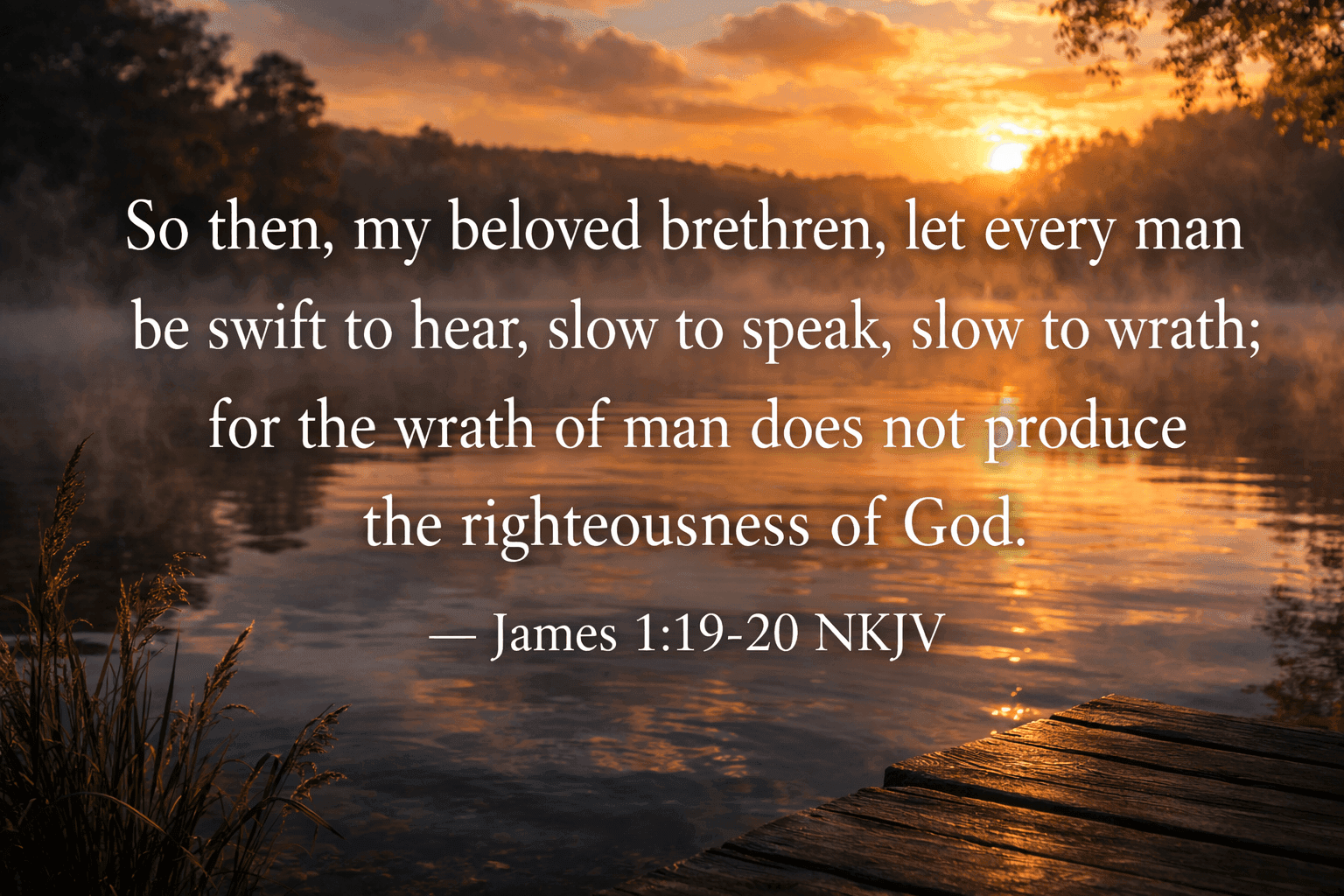
“So then, my beloved brethren, let every man be swift to hear, slow to speak, slow to wrath; for the wrath of man does not produce the righteousness of God.”
James 1:19-20
James puts the sequence in the right order: hear first, speak second, get angry last. Most of us reverse it completely. We get angry first, speak second, and never hear the other person at all. Notice he doesn't say “don't get angry.” He says be slow to get there. The space between the trigger and the response is where wisdom lives.
“A soft answer turns away wrath, but a harsh word stirs up anger.”
Proverbs 15:1
This is one of those verses that's easy to agree with and almost impossible to do at 11pm when you're exhausted and the person across from you just said the thing that always sets you off. A soft answer doesn't mean a weak answer. It means you lower the temperature instead of raising it. Someone has to go first. Proverbs says it should be you.
“He who is slow to anger is better than the mighty, and he who rules his spirit than he who takes a city.”
Proverbs 16:32
Ruling your spirit is harder than conquering a city. That's not a metaphor. Ask anyone who's ever clenched their jaw and walked out of the room instead of saying the thing that would have ended the conversation and maybe the relationship. That kind of self-control takes more strength than any fight.
“A fool vents all his feelings, but a wise man holds them back.”
Proverbs 29:11
Venting feels righteous in the moment. You're just being honest, right? But Proverbs calls it foolishness. Not because honesty is wrong, but because unfiltered honesty without timing or restraint is just a tantrum dressed up as truth-telling.
“Whoever has no rule over his own spirit is like a city broken down, without walls.”
Proverbs 25:28
A city without walls has no protection. Everything gets in. Every offense, every slight, every frustration walks right through the gate. If you can't control your anger, you can't protect anything that matters to you: not your marriage, not your friendships, not your kids' sense of safety in their own home.
“He who is slow to wrath has great understanding, but he who is impulsive exalts folly.”
Proverbs 14:29
Being slow to anger isn't weakness. It's understanding. It means you've learned that the first thing you feel isn't always the truest thing, and the first thing you want to say is rarely the wisest thing. The impulsive person makes their anger the loudest voice in the room. The wise person waits until they have something worth saying.
If you're reading this section because the explosion already happened, keep going. The section on rebuilding after the damage covers what to do next.
Resentment & Bitterness
When You Can't Let It Go
This is different from exploding. This is the slow burn. The thing someone did to you six months ago, two years ago, a decade ago, that you replay on a loop. You're not screaming. You're simmering. The anger has stopped being an emotion and started becoming part of who you are.
This is stored resentment. The kind that doesn't look dramatic from the outside but eats you hollow from the inside.
“'Be angry, and do not sin': do not let the sun go down on your wrath, nor give place to the devil.”
Ephesians 4:26-27
Paul isn't saying resolve every conflict before bedtime. He's setting a time boundary on anger. Feel it. But don't let it move in. Don't give it a room in your house and a key to the front door. Because when anger takes up permanent residence, it gives the devil a foothold. Not a dramatic, horror-movie foothold. A quiet one. The kind where bitterness becomes so normal you forget it's there.
“Let all bitterness, wrath, anger, clamor, and evil speaking be put away from you, with all malice. And be kind to one another, tenderhearted, forgiving one another, even as God in Christ forgave you.”
Ephesians 4:31-32
Paul lists bitterness first. Before wrath. Before anger. Because bitterness is where the rot starts. It's the stored anger that went underground and turned into something harder and colder. And the antidote isn't “try harder to forgive.” It's be kind. Be tenderhearted. These are practiced behaviors, not feelings. You won't feel tenderhearted toward the person who wrecked your life. You practice tenderheartedness until the feeling catches up, because Jesus forgave you when you didn't deserve it either.
“Looking carefully lest anyone fall short of the grace of God; lest any root of bitterness springing up cause trouble, and by this many become defiled.”
Hebrews 12:15
Bitterness has roots. It grows underground where nobody sees it, and by the time it breaks the surface, it has already infected everything around it. The writer of Hebrews says “many become defiled.” Not just you. Your bitterness defiles the people near you. Your kids absorb it. Your friendships distort around it. Your ability to receive anything good from God gets choked by it.
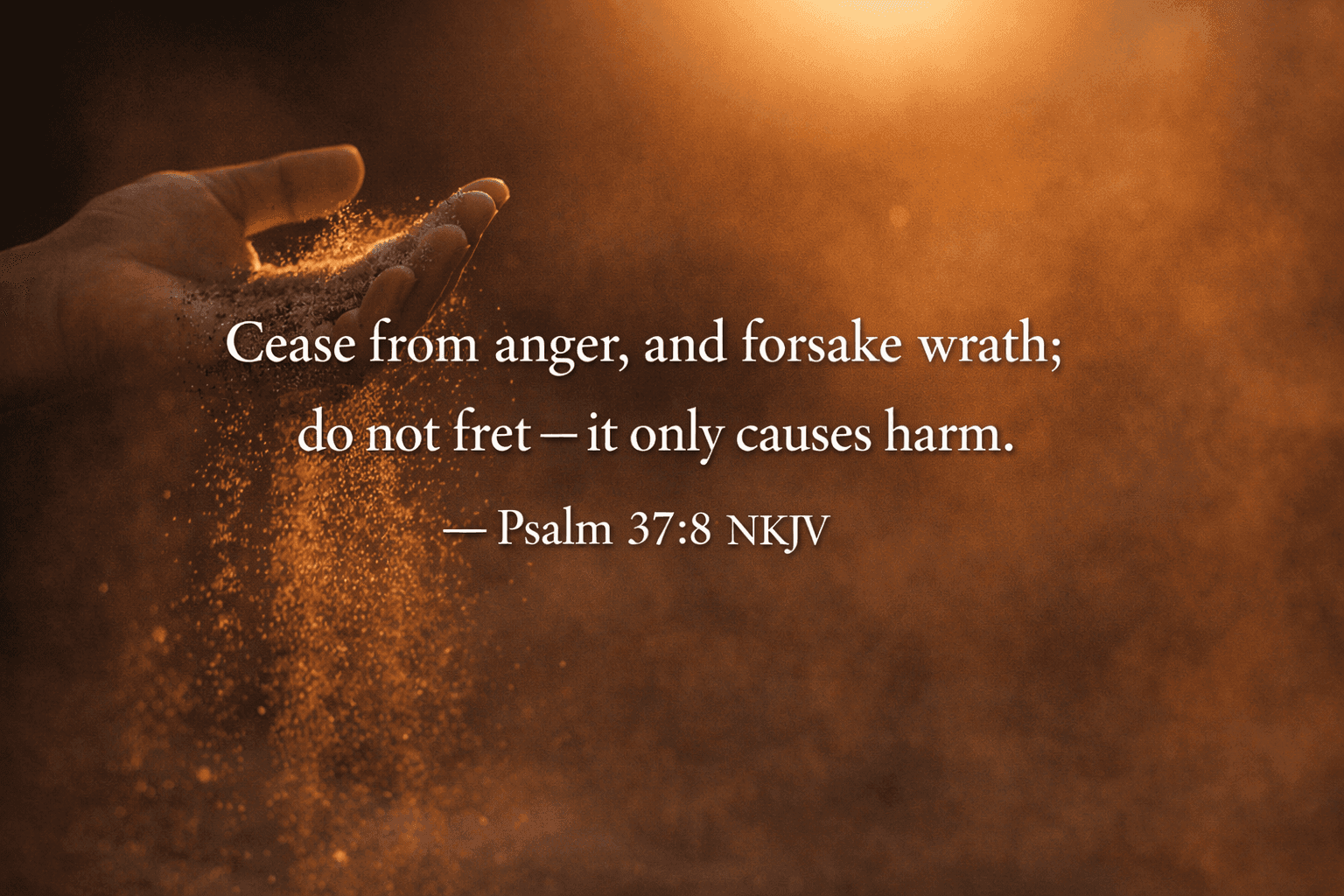
“Cease from anger, and forsake wrath; do not fret, it only causes harm.”
Psalm 37:8
David says fretting causes harm. Fretting is what happens when anger and anxiety have a kid together. It's the constant mental rehearsal of wrongs done to you, the imaginary arguments you win at 2am, the slow erosion of peace that happens when you refuse to release what someone did. It only causes harm. Not “it might cause harm.” Not “it sometimes causes harm.” Only. Every time.
“Beloved, do not avenge yourselves, but rather give place to wrath; for it is written, 'Vengeance is Mine, I will repay,' says the Lord... Do not be overcome by evil, but overcome evil with good.”
Romans 12:19, 21
The hardest command in the New Testament might be this one. Don't avenge yourself. Leave room for God to handle it. And while you're waiting, overcome evil with good. Not because the person deserves your goodness. Because holding onto the revenge script is slowly making you into someone you don't want to be.
If you've been carrying anger for years and you know it's poisoning you but you don't know how to put it down, rebuilding broken relationships is a place to start.
The Hardest Section
When You're Angry at God
This is the section nobody wants to write and everybody needs to read. If you've ever been furious at God for what He allowed, for what He didn't stop, for the prayer He didn't answer the way you needed Him to, you're not alone.
And the first thing you need to know is: the Bible is full of people who felt exactly the same way.
“How long, O Lord? Will You forget me forever? How long will You hide Your face from me? How long shall I take counsel in my soul, having sorrow in my heart daily?”
Psalm 13:1-2
David wrote that. The man after God's own heart. And he wasn't being poetic. He was asking God, to His face, “Have you forgotten me?” That's anger and grief tangled together, and God didn't strike him down for it. God put it in the Bible.
“My God, My God, why have You forsaken Me?”
Psalm 22:1
Jesus quoted this psalm on the cross. The Son of God, in the moment of ultimate suffering, voiced the feeling of being abandoned by His Father. If Jesus could say that out loud, you can bring your anger to God without pretending it's something politer.
“O Lord, how long shall I cry, and You will not hear? Even cry out to You, 'Violence!' and You will not save.”
Habakkuk 1:2
Habakkuk was a prophet watching injustice tear his nation apart, and he didn't write a careful prayer about trusting God's timing. He said, in effect, “I've been crying out and You're not listening.” God didn't punish him. God answered him. The answer was hard, but God showed up.
“Then Jonah prayed to the Lord, and said, 'Ah, Lord, was not this what I said when I was still in my country?... for I know that You are a gracious and merciful God, slow to anger and abundant in lovingkindness, One who relents from doing harm.'”
Jonah 4:1-2
Jonah was angry at God's mercy. He wanted Nineveh destroyed and God forgave them instead. God's response wasn't a lecture. It was a question: “Is it right for you to be angry?” (Jonah 4:4). Not a rebuke. A question. God engages with your anger. He doesn't dismiss it.
“My soul loathes my life; I will give free course to my complaint, I will speak in the bitterness of my soul. I will say to God, 'Do not condemn me; show me why You contend with me.'”
Job 10:1-2
Job lost everything. His children, his health, his livelihood. His friends told him it was his fault. And Job did the thing we're all afraid to do: he argued with God directly. He demanded answers. The entire book of Job is a man shaking his fist at the sky. And at the end, God showed up. Not with an apology, but with His presence. And for Job, that was enough.
Martha did it too. When Lazarus died, she went straight to Jesus and said, “Lord, if You had been here, my brother would not have died” (John 11:21). That's grief and anger fused together. “You could have stopped this and You didn't.” Jesus didn't correct her theology. He wept with her. Then He raised Lazarus from the dead.
Anger at God is not the same as rejection of God. It's the opposite. You don't yell at someone you've given up on. You yell at someone you still believe can do something. Suppressing your anger at God doesn't make you more faithful. It makes you more distant. Bring it to Him. He can take it.
If you're carrying grief alongside anger, these scriptures for grieving may help with the other side of what you're feeling. And if the anger is mixed with a depression that won't lift, these verses for depression address that intersection directly.
Support the Work
Help Keep
the Door Open
Recovery doesn't happen by accident. It takes people willing to fund the bed, the meal, the mentor, and the long road back.
Your gift provides Christ-centered recovery referrals, resources, and family support for people rebuilding their lives in the Shenandoah Valley. Be the reason the next one makes it.
Righteous Anger
When Anger Is the Right Response
If this page only told you to suppress anger, you'd stop reading. And you should. Because the Bible doesn't say all anger is wrong. It says some anger is exactly right.
“And when He had looked around at them with anger, being grieved by the hardness of their hearts, He said to the man, 'Stretch out your hand.'”
Mark 3:5
Jesus was angry. And He was grieved. At the same time. That's the marker. Righteous anger is always grief-adjacent. It's not rage at someone who disrespected you. It's the gut-level response to something that should not be the way it is.
“Then Jesus went into the temple of God and drove out all those who bought and sold in the temple, and overturned the tables of the money changers and the seats of those who sold doves.”
Matthew 21:12
Jesus didn't lose His temper in the temple. He braided a whip. That takes time. This was deliberate, purposeful action against exploitation happening in His Father's house. He didn't punch a Pharisee. He flipped the tables of the system that was crushing poor people trying to worship God. That's the difference between righteous anger and the kind that makes you feel powerful.
“Then I was very angry when I heard their outcry and these words.”
Nehemiah 5:6
Nehemiah's anger at the oppression of the poor didn't lead to a rant. It led to reform. He confronted the nobles, demanded restitution, and restructured the economy so the poor weren't being crushed by their own people. His anger produced justice, not destruction.
“God is a just judge, and God is angry with the wicked every day.”
Psalm 7:11
God's anger is constant and it's tethered to justice, not self-protection. He's not angry because His ego was bruised. He's angry because the vulnerable are being exploited. That's the kind of anger Scripture validates.
“And the Lord passed before him and proclaimed, 'The Lord, the Lord God, merciful and gracious, longsuffering, and abounding in goodness and truth.'”
Exodus 34:6
“Longsuffering” is the NKJV translation of “slow to anger.” God experiences anger. But He holds it. Controls it. Uses it for restoration, not destruction. That's the model. Anger that makes you want to fix something might be righteous. Anger that makes you want to hurt someone is not.
Three marks of righteous anger: it's about someone else's pain, not yours. It leads to action, not destruction. And it's grief-adjacent, not power-adjacent. Jesus wept before He raised Lazarus. He was grieved before He confronted the Pharisees. If there's no grief in your anger, check what's really driving it.
What's Underneath
When Anger Is Masking Something Else
Sometimes anger is the real problem. But more often, anger is the bodyguard standing in front of the thing you don't want to feel. Grief. Fear. Shame. Rejection. Those emotions feel vulnerable. Anger feels powerful. So anger shows up first, and if you never look behind it, you'll spend your whole life treating the wrong thing.
Scripture is full of people whose anger was really about something else.
Elijah Under the Broom Tree
1 Kings 19:4-8
Elijah had just called down fire from heaven, defeated 450 prophets of Baal, and outrun a chariot in the rain. Then Jezebel threatened him and he ran. He collapsed under a tree and asked God to let him die. Was he angry? Yes. But underneath the anger was exhaustion, isolation, fear, and depression. All four at once.
God's response is one of the most pastorally brilliant moments in all of Scripture. He didn't rebuke Elijah. He didn't give him a verse. He fed him. Twice. Then He let him sleep. Then He fed him again. Only after Elijah was physically restored did God ask him what was going on.
Sometimes the most spiritual thing you can do when you're angry is eat something and go to bed. That's not a cop-out. That's the Elijah model. God addressed the body before He addressed the soul.
Jonah Outside Nineveh
Jonah 4:1-9
Jonah said he was angry enough to die. But his anger at God's mercy toward Nineveh was really about loss of control. His prophetic identity was threatened. He'd predicted destruction and God changed the ending. Underneath the anger was grief over losing the one thing that made him feel significant. God didn't argue with the anger. He asked what was really going on.
Cain
Genesis 4:5-7
God asked Cain directly: “Why are you angry? And why has your countenance fallen? If you do well, will you not be accepted?” The anger was about rejection and jealousy. God gave Cain a chance to name the real thing. He didn't. And the anger he refused to examine turned into the first murder in human history.
Martha at the Tomb
John 11:21-27
“Lord, if You had been here, my brother would not have died.” Her anger was grief wearing a mask. Jesus didn't argue with the mask. He didn't correct the theology. He addressed the grief underneath, and then He did what only He could do.
The HALT Framework: A Recovery Tool That's Biblically Sound
If you've spent any time in recovery circles, you've heard HALT: Hungry, Angry, Lonely, Tired. It comes from AA and NA, but it maps onto Scripture so cleanly that it's worth using as a self-check whenever anger shows up unexpectedly.
Hungry
Elijah's story. God fed him before He talked to him. Don't make decisions, don't confront people, don't send the text when your body is depleted. James 1:19 says be slow to speak. That's a lot easier when your blood sugar isn't crashing.
Angry
Ephesians 4:26-27 gives you a time boundary. Don't store it. Don't let the sun go down on it. The devil uses unresolved anger as a foothold, and he's patient enough to wait while you tell yourself you'll deal with it later.
Lonely
Isolation breeds resentment. When you're disconnected from people, every offense gets magnified because there's nobody to give you perspective. Romans 12:18 says, “If it is possible, as much as depends on you, live peaceably with all men.” Connection is the antidote to the resentment that builds when you're alone with your thoughts.
If you don't have a community right now, finding a recovery meeting is a practical next step.
Tired
Your anger threshold drops when you're exhausted. Proverbs 15:1 says a soft answer turns away wrath, but a soft answer is nearly impossible when you haven't slept in three days. Sometimes the wisest, most spiritual decision you can make is to not engage right now and go to bed.
Why This Matters in Recovery
In early sobriety, anger hits differently. When the drugs or alcohol stop numbing everything, all the emotions you were running from come flooding back. And anger is usually the first one through the door, because it feels strong. Grief feels weak. Shame feels unbearable. Fear feels pathetic. But anger? Anger feels like you're finally doing something.
The guys who make it through that stretch are the ones who learn to ask, “What's under the anger?” The ones who relapse are often the ones who never looked past it. Anger is a real emotion and it deserves to be felt. But if it's the only emotion you'll let yourself feel, it's a wall, not a window. Preventing relapse starts with recognizing the warning signs, and unchecked anger is near the top of the list.
If you're in early recovery and the anger feels overwhelming, that's normal. It doesn't mean you're failing. It means you're finally feeling things you spent years avoiding. The question is what you do with it now. There's a longer conversation about what freedom after addiction actually looks like that picks up where this section leaves off.
Rebuilding After Damage
When Your Anger Cost You Something
This section is for the person who already exploded. The words were said. The relationship is damaged. The trust is broken. You can't unsend the text. You can't un-say the thing you said at Thanksgiving. Now what.
“Therefore if you bring your gift to the altar, and there remember that your brother has something against you, leave your gift there before the altar, and go your way. First be reconciled to your brother, and then come and offer your gift.”
Matthew 5:23-24
Jesus puts reconciliation before worship. Not after. Before. If there's someone you've wronged and you know it, your next spiritual act isn't a prayer meeting. It's a phone call. It's showing up. It's saying “I was wrong” without the word “but” attached to it.
“Moreover if your brother sins against you, go and tell him his fault between you and him alone. If he hears you, you have gained your brother.”
Matthew 18:15
This verse cuts both ways. If you're the one who was wronged, go directly. Not to social media. Not to your small group. To the person. And if you're the one who did the damage, the same principle applies: go to them, not around them.
“Take heed to yourselves. If your brother sins against you, rebuke him; and if he repents, forgive him. And if he sins against you seven times in a day, and seven times in a day returns to you, saying, 'I repent,' you must forgive him.”
Luke 17:3-4
Jesus sets up a brutal math problem. Seven times in one day. That's not about a specific number. It's about the posture. Forgiveness isn't a one-time event. It's a repeated decision. And the hardest part is that Jesus puts the burden on the one who was sinned against. You must forgive him. Not “you should think about forgiving him eventually.” Must.
“And be kind to one another, tenderhearted, forgiving one another, even as God in Christ forgave you.”
Ephesians 4:32
The standard for forgiveness is what Jesus did for you. That's an impossible standard on your own. Which is exactly the point. You can't manufacture this kind of forgiveness through willpower. It comes from understanding how much you've been forgiven.
“Make no friendship with an angry man, and with a furious man do not go, lest you learn his ways and set a snare for your soul.”
Proverbs 22:24-25
This one is harder to hear if you're the angry person. Proverbs says people should keep their distance from someone who won't deal with their anger. That's not cruelty. It's wisdom. If you're the person others are avoiding because of your temper, that's information. And if you're the person who keeps getting burned by someone who refuses to change, it's OK to forgive them and still set a boundary. Forgiveness doesn't mean tolerance.
Forgiveness isn't a feeling. It's a sequence. Name the offense truthfully (Matthew 18:15). Refuse the revenge script (Romans 12:19-21). Practice replacing bitterness with kindness, even when you don't feel like it (Ephesians 4:31-32). Accept that you might need to forgive the same person more than once (Luke 17:3-4). And sometimes, the wisest thing is to forgive AND create distance. Not every relationship needs to be restored to its original form. Some just need to be released.
Taking the Next Step
Anger is real. The Bible takes it seriously and so should you. Whether you're in the middle of the explosion or carrying something that's been burning for years, there is a path forward. It starts with being honest about what you're feeling and bringing it to God instead of burying it or letting it run unchecked.
If the anger you're dealing with is connected to addiction, whether your own or someone you love, we can help you figure out the next step.
If you need more Scripture for what you're going through:
- Bible Verses for Depression
- Bible Verses for Anxiety
- Bible Verses for Grieving
- Bible Verses for Addiction
- Bible Verses for Hope
Hear more on our podcast: Rebuilding Life After Addiction.
FAQ
Frequently Asked Questions About Anger in the Bible
Is anger a sin according to the Bible?
+
Not automatically. Ephesians 4:26 says "Be angry, and do not sin," which means anger itself is morally neutral. What makes it sinful is what you do with it: explosive violence, stored bitterness, revenge, cruelty. Even Jesus expressed anger (Mark 3:5). The issue isn't the emotion. It's whether it controls you or you steward it under God's direction.
What does "be angry and do not sin" mean?
+
Paul is setting a time boundary on anger. Feel it, but don't let it take up permanent residence. "Do not let the sun go down on your wrath" means deal with it before it becomes a foothold for the enemy. Unresolved anger doesn't just fade. It ferments into bitterness, resentment, and eventually relational destruction. The instruction isn't to never feel angry. It's to refuse to let anger become the thing that defines how you treat people.
What does "slow to anger" mean in the Bible?
+
It's a divine attribute first. Exodus 34:6 and Psalm 103:8 describe God as "slow to anger." The Hebrew word for anger (aph) literally means "nostril," the flare of the nose when emotion surges. "Slow to anger" means the space between the trigger and the response is long enough for wisdom to enter. Proverbs 16:32 says ruling your spirit is harder than conquering a city. This is strength, not passivity.
Is it OK to be angry at God?
+
The Psalms are full of people who were. David, Habakkuk, Job, and even Jesus on the cross quoted "My God, My God, why have You forsaken Me?" Anger at God isn't rejection. It's the opposite. You don't yell at someone you've given up on. Jonah was furious at God and God responded with a question, not a punishment: "Is it right for you to be angry?" (Jonah 4:4). Bring your anger to God directly. He can handle it.
What is righteous anger?
+
Anger that's about someone else's pain, not yours. Anger that leads to action, not destruction. Anger that's grief-adjacent, not power-adjacent. Jesus cleared the temple because people were being exploited. Nehemiah confronted oppression. Righteous anger produces justice. If your anger makes you want to hurt someone, it's not righteous. If it makes you want to protect someone or fix an injustice, it might be.
How do you deal with anger biblically?
+
James 1:19 gives the framework: be quick to hear, slow to speak, slow to anger. Practically: pause before you respond (Proverbs 15:1), check your body (are you hungry, tired, isolated?), set a time limit on unresolved anger (Ephesians 4:26), and if you've already done damage, go make it right (Matthew 5:23-24). Don't stuff it down. Don't let it explode. Name it, bring it to God, and act from wisdom instead of heat.
What does the Bible say about anger and forgiveness?
+
Forgiveness in Scripture is a process, not a single moment. Name the offense truthfully (Matthew 18:15). Refuse the revenge script (Romans 12:19). Replace bitterness with practiced kindness (Ephesians 4:31-32). Accept that you might need to forgive the same person more than once (Luke 17:3-4). Forgiveness doesn't mean pretending it didn't happen or removing all boundaries. It means releasing the right to retaliate and trusting God with the outcome.
Can anger cause relapse?
+
Yes. HALT (Hungry, Angry, Lonely, Tired) is a core recovery framework because those four states lower your defenses. Unresolved anger is one of the most common triggers for relapse. In early sobriety, emotions that were numbed for years come flooding back, and anger usually arrives first because it feels powerful. Learning to name what's underneath the anger, whether that's grief, shame, or fear, is critical to staying free.
Keep Reading
5 Prayers for Families Still in the Fight
When you don't know what to pray anymore, start here. Drop your email and we'll send you the free one-page guide. You'll also get one email a week. Real stories from real families navigating addiction and recovery.
No spam. Unsubscribe anytime.

Justin Franich
Justin Franich is a former meth addict, Teen Challenge graduate, and pastor who has been clean since 2005. Today he's a husband, father, and Executive Director of Shenandoah Valley Adult Teen Challenge. He hosts the Rebuilding Life After Addiction podcast and helps families across the U.S. navigate faith-based recovery options, compare programs, and rebuild life after addiction.
Read my story →