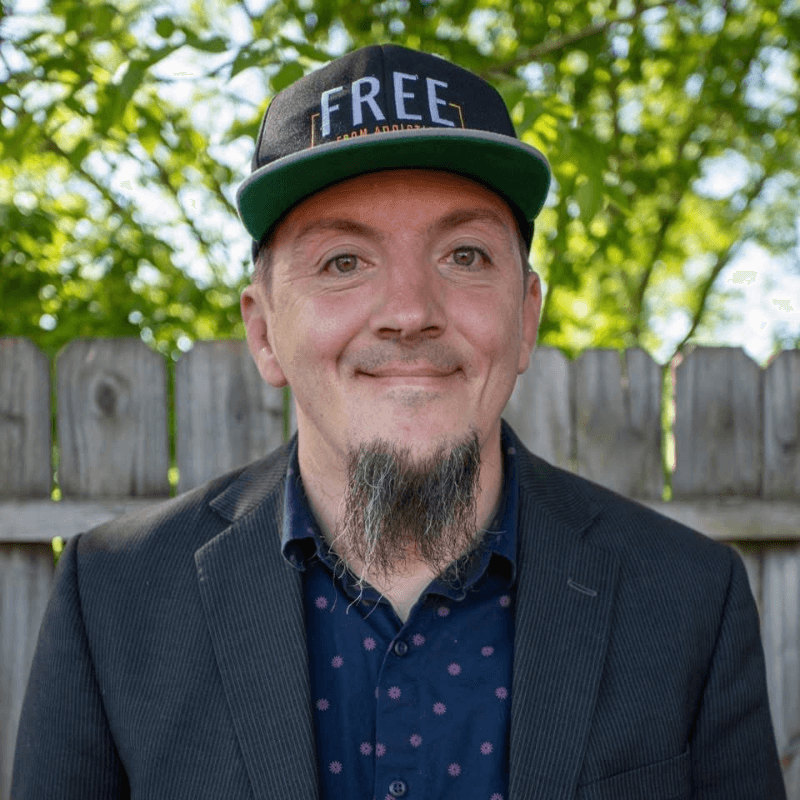
Clean and Sober. Now How Do You Get a Job?
Rebuilding Life After Addiction — with Shayne Weister
At the Table Again
Justin: Hey, welcome everybody to another episode of Rebuilding Life After Addiction. I'm here with my friend Shayne Weister, and we're again at The Table 61, in the garage, filming another conversation while the rest of this furniture waits to go out the door.
Shayne and I have had some discussions over the last couple of months about this, really the whole thesis of the podcast. It's rebuilding life after addiction and getting to that place of purpose. Not just the testimony of coming off drugs, but the testimony that belongs after, the building afterward. The increased testimony.
Before we jump into the topic, why don't you introduce yourself, tell people what you do, and then we'll get into it.
Shayne: Sure. My name is Shayne Weister. What I do for a living, I'm actually a beekeeper by trade. The calling of my life is agricultural evangelist. So wherever the Lord leads me, I go and do the work of God, either with my hands or speaking the words He's given me. And God's given me a small business to fund myself and provide for my wife, through beekeeping and honey production, and just walking it out with people. Talking to young entrepreneurs and folks getting their lives cleaned up, how they can build a new life and work hard. That's a little bit about me.
The Testimony That Stops Too Early
Justin: We've talked about this a few times. You see men, specifically young men, go through residential recovery programs, or they have an encounter with the Lord and decide they no longer want to live the lifestyle of drugs and alcohol. And there's so much emphasis and energy on, yes, it's important, God did the miraculous. I've been a recipient of that myself.
But then the testimony just kind of stops there for a lot of these guys. And not all of them relapse. But it seems like there's sometimes a struggle to start moving forward.
Shayne: The biggest issues I see with that are motivation and work ethic. A lot of folks may have lapsed into bad habits, or they have character flaws. Even a lot of the folks raised in church, that solid work ethic often wasn't something instilled in them. So when we see guys coming out of the program, I myself struggled with it. I'm a hard worker, but motivation, I still struggle with being motivated today.
So I think the biggest challenge is good discipleship. That's one of the areas of lack I really see right now. It takes a person to engage those who are struggling, and it can be risky. People feel a lot of risk in that. So you have to be motivated.
And when these guys get themselves squared away, their legal issues squared away, then what's the next step? Some of them have been messed up for so long they've never worked. They have to realize it's time to get to work. That's what it's going to take to rebuild a life. You have to have some skin in the game.
The Man by the Tombs
Justin: Yesterday I had a conversation with a good friend about finances and the work of rebuilding them. Jacob talked about a lot of very practical, Dave Ramsey type stuff. One of the things we landed on first was, once you realize how much you owe, you get an idea of the wreckage, and you've got to go to work and start working your way out.
So for a guy who's fresh into his relationship with God, clean off drugs, he's the man by the tombs, well clothed, sitting there. I have no idea what to do next. All I've known is drugs. All I've known is that lifestyle of addiction. How do I figure out what to do from here? How do I get started?
Shayne: This is an area that's lacking right now, especially for Christian people. In my secular pursuits, before I went more full time into agricultural evangelism and missionary work, I worked in government programs that provided transitional employment and mentorship for young adults, 17 to 24. It was federally funded, not faith based.
But the first thing is, get a mentor. Get someone, especially if you're coming out of a program. There's got to be a place of connection. There's got to be somebody. And this is an encouragement to anybody watching. If your church doesn't currently offer that, or your men's ministry isn't offering that, it's a really good opportunity to be a hub, a resource, a source of encouragement. There are a lot of trauma issues to be addressed. Lifestyle choices to be addressed. The first thing is to find yourself a mentor who can engage and share information with you.
What to Look For in a Mentor
Justin: It's funny, I went right into ministry when I got out of Teen Challenge. Everything I'd done prior was some food service jobs for short stints in my teenage years. I really didn't understand vocation, didn't understand what God had gifted me to do. So in your experience working with young men, how do you help people uncover that? And what am I looking for in a mentor?
Shayne: You obviously want somebody with a solid track record of success. Somebody who's built something, who knows what success looks like. Somebody who isn't piled up in debt. Not all about the flashy things. Somebody consistent, and somebody who may even share in your struggle.
For me, one of the most frustrating parts was that I had skills, I was an intelligent guy, I had education, and then I made some life-altering choices as a young man that stopped all that. I'm a little older, so it was harder back then. There weren't a lot of people lining up, because I was confused. I didn't know what to do. My mistakes really limited me. I couldn't meet my full potential.
So working with young guys, it's about building a very trusting relationship where they actually want to talk about how they're feeling. If you've been defeated so many times, the last thing you want to do is share your dreams with somebody. So find somebody you can trust. And be somebody that somebody can trust. Missionary work is relational. It's long term. It's consistency, building relationships to the point where they want to start sharing with you.
You see older guys especially, like, my life's half over, what am I going to do? And there's hope for everybody. Things change. It did for me. So begin to unpack what that goal was. There are ramifications for our actions, but I went on to build a healthy career. I had to give an account for some of the things I'd been involved in as a younger man. But you can't get in your own head. You can't think it's all lost. Find somebody positive, be somebody positive, write those things down, and remind yourself you're not defeated.
Finding Work That Won't Pull You Back
Justin: Practically speaking, I'm day one out of a program. I'm trying to find a mentor, find those relationships. But where do I start? Environment is everything. How do I find a job that meets my needs but isn't a trigger that pulls me back into my old life?
Shayne: That's a challenge, because you're looking at entry-level jobs, which can feel demeaning and defeating sometimes, especially if you're a little older. Unfortunately, that's where some of it has to start. Vocational training is very important. Housing too, especially if you're displaced.
One of the challenges of re-offending is that people don't have a place to go. The very thing that set them up to fail in the first place is still there. A dysfunctional family, or no family, no place to stay, nobody contributing to their well-being. So from a faith-based perspective, you have to be housed, you have to be around positive people, you can't go back around the old things.
I think jobs that let you serve people, not just menial tasks, but something that contributes to the needs of others. There are federal programs for that. There are some limitations for folks with criminal records, especially felonies, but not always, so don't count yourself out. There are nonprofits in Maryland and West Virginia looking for folks for entry-level work. That's where it starts. Build a plan. And I always encourage everybody, get some training.
Get Some Training
Justin: What does that look like?
Shayne: There's tons of grant money to go to college for the first time, or trade school. And if you say, well, I'm not a blue collar guy, I'm a musician or an artist, I like to write, there are still things you can apply yourself to. Training sets a foundation. Education shows that you committed yourself to something, that you want to better yourself. It's good on your resume, and you're going to learn something.
So change your environment, get some training, find people, get some job skills. There are programs and nonprofits that work with people on their GED if you don't have a high school diploma. Sit down, build the plan, look at the shortcomings in your life, and address them. Start with what you don't have, the diploma, the skills, then explore what you like to do, and look into a community college or trade school. Then take those entry-level jobs.
We always joke about brands like Chick-fil-A, but their model is exceptional. There's accountability there, positivity, fairly decent wages. So when you ask what to do, you're going to take an entry-level job, and you look to companies that work well for that.
Justin: It takes a level of humility. You go out looking for a job and it's like, I can't live on $14 an hour, that's not a living wage. But $14 an hour while you're starting is better than zero dollars an hour. And sitting around with an idle mind, that's when you start figuring out hustles and schemes. If you just get started, your first job doesn't have to be your forever job.
From Losing His License to Beekeeping
Justin: When you started rebuilding your life, it's not like you landed on beekeeping twenty years ago and knew you'd be doing this today.
Shayne: No. I have a very successful apiary enterprise today, but it came through steps of obedience. It wasn't even what I thought I'd be doing ten years ago.
My story is, I was away at college, had some unresolved issues, came home, had a legal issue, and lost my driver's license. This was 1997, a long time ago. At that point I had some skills. I'd worked in property management, landscaping, groundskeeping. I was a sharp guy, I wanted to go to college, but without a license I had to change my environment. I didn't right away. I went back to some of the things I was doing, and it started snowballing in the wrong way.
Fortunately I had some praying people in my life, and I was a churchgoing guy, just not really committed to that lifestyle. So I started all over. Ten bucks an hour. It was miserable, working with guys who were nowhere. But I was consistent. Consistency is crucial. Showing up, putting in your time. I built a very successful property management career, and that folded into the mentorship programs, where I had direct access to people I could work with. I had a backstory to contribute. Hey, don't do this. Hey, do that.
One of the mistakes people make is they start to cohabitate really quickly. They get out, don't have a place to live, and start living with other people who don't have a place, or they get into the wrong relationships, and you compound the problem. It goes from financial to cultural and relational, and then you feel trapped all over again.
So I made a decision. The Bible says, despise not small beginnings. And steady plodding builds wealth. There's no get-rich-quick scheme according to the Bible or according to life. When I became a beekeeper, I started that business on a whim. It wasn't even a business, it was a hobby. As my wife says, I didn't mean for you to go into business. With a thousand bucks and three beehives, that's how we started ten years ago. The right relationships, staying consistent, and opportunities.
I committed my life to Christ in 1997 and 1998, because I had messed it up that bad. So I always tell people, you've got to have a good foundation. When you go into business you have to have a business model, and the same is true coming out of rough spots. You have to have a plan for life, be consistent, and keep moving forward.
Failure Isn't Terminal
Justin: Failure is part of the journey. How has your relationship with failure changed now versus back then?
Shayne: My greatest successes have come on the backs of my worst failures. Anybody successful, every successful person I know, chuckles at their failures, because it was them trying to move in the right direction.
Thirty years ago I was defeated. When you've never really been successful, or you've got issues going on, and honestly, in your early 20s it's just difficult if you haven't had positive people in your life. I didn't always have those people speaking life into me. A lot of negativity. So in defeat, I just quit. I was a perpetual quitter.
Now I'm not a quitter to a fault. The pendulum swung hard the other way. When I dive into something now, I don't know when to stop, until burnout and fatigue set in, because I'm trying to remediate my failings as a young person.
Failure as a young person led to quitting. It was terminal. Failure was terminal. It is not terminal for a successful person. Failure is the fodder that sets our dreams ablaze.
Justin: Most great creativity comes out of constraint. When we don't have the resources, when we feel backed into a corner, that's when we have to come up with solutions.
Shayne: Right. And people end up in a comparison trap. They see other people's journeys and think, I've got to do it exactly that way. This guy became a recovery influencer, so that's what I'm going to be. Rather than knowing God is charting their course step by step.
Pouring Into Others First
Justin: Was there a specific moment your view of failure shifted?
Shayne: Part of my journey, when I started getting my life squared away, my wife and I got married and started having kids right away. We'd both come out of some stuff. Almost thirty years later, we're still figuring it out.
I came into the marriage as what I perceived as a failure. So I started diverting all that energy into the success of my children. I had to come second. Not feeling successful in my own life, I had to come up with positivity to invest in my kids, and then those around me. And people started migrating to me.
It was frustrating, because I saw the people around me becoming more successful than I perceived myself, and I was the one contributing. But I was contributing from my own place of hurt and disappointment, because I had the potential. It wasn't until my kids graduated high school that I could really start focusing on myself. I'd worked on other people because I'd made decisions that put my own life on hold. But I wasn't going to put my kids' lives on hold, or the lives of the people who came in contact with me.
Because I knew what I was made to do. I was made to pour into other people. We all are. People want to know their calling. Act like Christ, be like Christ, contribute to the well-being of others, and put yourself second or third or last.
Then God put me in a place, my kids were adults, moving on, and we found ourselves in some transition. And I realized I'm not a failure, because the people whose lives I'd contributed to were living out the plan that was on my heart, and they were becoming successful. So I thought, wait a minute, I can use the plan God gave me for myself now too.
In the beginning I failed. If I'd taken that as final, we'd have been divorced, I'd never have seen my kids again, I'd have thrown in the towel 28, 29 years ago. We stayed with it. It wasn't always pretty. Success is a lot of toil, strain, striving, hurt, and disappointment. But consistency is the key. When my kids became adults, I saw them make it, I saw people in my life being successful, and I thought, it's working. My low self-esteem, my negative self-image, my lack of self-worth, those were all real. People who knew me would say, there's no way a guy like you feels that way. But it was all a front. Behind the scenes I was falling apart, channeling all that energy into others. When I saw my successes through the lives of other people, I began to work that same program on my own life.
Proximity and the Right Rooms
Justin: One of the things you and I talk about a lot is relationships, and how proximity matters. God putting you in rooms with people where you look around and think, how did I get here? I've had those moments. Even in the last 60 days, what God has done in the ministry has all come through relationships. But that seems impossible when you're first rebuilding and your entire circle is destructive. How do I start getting myself into places with people who can help me go forward?
Shayne: You have to change your mindset. Years ago, when I walked into a room, I felt like the room was asking, what are you doing here? Now I walk in like, how did I get here? It can be intimidating, and I'm not intimidated by anything except myself.
A story. About five years ago I was a volunteer missionary down in the city. I was pretty confident when I got there. I told the director, I don't want anybody's help with anything. I'm going to make my own way. And he said, how do you think you got here? It's because you knew somebody.
For me, knowing somebody had a negative connotation. When you're broke and battered and embittered, resentment sets in, and broken people start to resent successful people. Oh, they just knew somebody. Nobody ever helped me like that. That was the day I realized, well, I do know people. And favor, where does favor come from for the Christian? From God. So you've got to see it correctly.
It's nuts when I get in the room sometimes, the places I end up. A couple weeks ago I'm teaching at an elementary school. I'm meeting with business people, doing sponsored events, and they want me to come hang out as a small business owner and entrepreneur. And when I walk in the room, even today, I think, I hope they don't know what I was.
That still happens. Even saying it right now, there's a wave of emotion in me, literally almost bringing me to tears. Because I walk in like, if they knew what I was, they wouldn't have me here. And that's not from God. That anxiety, the feeling that somebody in here is going to say, I know what you were, I've got the video, I've got the pictures, none of that's true. It's not true for me, and it's not true for most of you.
Joseph and the Man He Met
Shayne: The Lord just dropped this on my heart. Joseph ended up in front of Pharaoh, interpreting the dream, because of somebody he met in prison. The word tells us, if your work is excellent, you will be presented to kings. I subscribe to that. If I work hard and my work is tight, people ask why I'm so particular about things. Because it matters. It's a direct representation of me, and of the Lord. We're imperfect, we'll never be perfect, but what God has given us to do, we do as unto the Lord, which means we strive for excellence.
Justin: I think about the people I've known over the years who were a hot mess, just like me. And I look at their lives twenty years later and they're completely different people. I always encourage people, especially early, to distance yourself from friends who are still using. But going back to your point, Joseph ended up in front of the king because he met somebody in prison.
Shayne: It was the butler or the baker that he met in prison who ended up speaking on his behalf. Hey, I know a guy who can interpret this dream. And he ended up in front of Pharaoh, ultimately running the entire land.
Justin: A lot of times we have an idea of what success looks like, and we frame people from our perception of it, rather than just getting close to people. Like you said, it's about serving other people. Service is influence. That's all it is. There's a quote that goes around: when I'm the CEO, I want to treat the janitor with the same respect as the CEO. But we only say that from the other end of success. We don't say it when we're still the janitor. There's a process of pouring into people and loving people, because you never know who God has put in your proximity. You may be blowing your opportunity just by not loving the person in front of you.
The Barefoot Valedictorian
Shayne: One of the greatest stories of success in my life, as a very dysfunctional dad who raised two kids to success. When our kids graduated high school, I've got one who's low key, takes it as it comes, no peaks and valleys. And another who's borderline Pharaoh, an overachiever, strong willed. That one was class valedictorian and has excelled. Both have excelled, but one doesn't care about it and the other needs things to be just right.
When my daughter graduated, she walked the platform barefoot. I'm like, what is going on? And in her speech, she thanked the Hispanic cleaning lady and the maintenance guy first, before she thanked her mom and dad. She said, when you grow up and your dad's a ditch digger for a living, you learn to thank the little people first. And she said, I want to come in sideways in a cloud of dust, knowing I've left it all out there.
I knew I had succeeded watching both those kids grow in their careers. If I never did another thing in life except watch those kids walk that platform, that was one of the things I got to do. Now they've gone on, replicating the model, putting themselves around the right people, and people want to be around them.
You have to have people in your circle you can trust, and you have to be somebody people can trust and share their struggles with. They know I'm going to tell them the truth. When they share a struggle with me, I say, let's get a plan here.
Don't Be Ashamed to Ask for Help
Justin: There have been a lot of positive takeaways in this. It's understanding there's a journey. It started with mentorship and ended with relationship. A lot of people know to just go apply somewhere, but it's getting around other people who can see the vision for your life when you can't see it yourself. It takes people at a different level to pull you up, because we've been living down here so long. The nervous system, the way we see the world, all of it has to be transformed and renewed over time.
Shayne, as we wrap up, how can people connect with you and buy some honey?
Shayne: I'm the owner of Glory Ridge Farm. You can find us online and on social media. You can reach me through Pastor Justin, or find me, Shayne Weister, on Facebook. I'm old school, a Gen Xer, so we're like the coolest older people around. Fourteen-year-olds trapped in an old man's body.
And don't be ashamed to ask for help. People see me and talk to me like, you wouldn't understand, you're successful. I'm like, no. I wish I had my old photos to show you. One of the pleasures I have now is being a mentor, even to my adult kids. I just continue to contribute to my peers, being relational. Ask for help. Don't be ashamed. Reach out to Justin. A brief conversation, a text, a private message, an email can put you on the path. I can inspire you, but I can't motivate you. You have to motivate yourself. You've got to dig in and put in the work.
Justin: And motivation doesn't last, which is why you have to do it daily. You have to make that decision, leaning into the Holy Spirit, but sometimes you've just got to get out and grind before you can see it.
I'll link Shayne's business and information in the description and in the comments. If you're watching along, drop a comment. What are some of the struggles or barriers you've seen, whether you're in recovery or walking this journey yourself? Or maybe you love someone in recovery and you just don't know what to do. Any question you have, drop it in the comments.
Thank you all for following along. Because of this social media community, in the last month we have furnished the sober living home, filled a refrigerator with food, and sold almost a half a truckload of furniture in just the last three weeks, because you keep showing up. So thank you. Everything you do helps put this message of hope and rebuilding in front of those who are struggling to get back on the journey of life.
Shayne, thank you so much for a great conversation.
Shayne: Glad to be here.
Justin: We'll see you in the next one. God bless.
Connect with Shayne Weister at Glory Ridge Farm: https://gloryridgefarm.com
If you or someone you love needs help, start here: https://svtc.info/get-help
More on what comes after the program: https://svtc.info/life-after-rehab-what-happens-when-treatment-ends
Rebuilding Life After Addiction is a production of Shenandoah Valley Teen Challenge, a faith-based recovery and discipleship ministry in Mount Jackson, Virginia.