Everything's on Fire
Jacob: When you're first recovering, everything's on fire. You put the source of the fire out. Now it's about stepping back and saying, where are the other embers still burning so we can stop that fire? Finances is one of them. Relationships is another. Part of putting that out and rebuilding is having a solid foundation.
Why We're Talking About Money
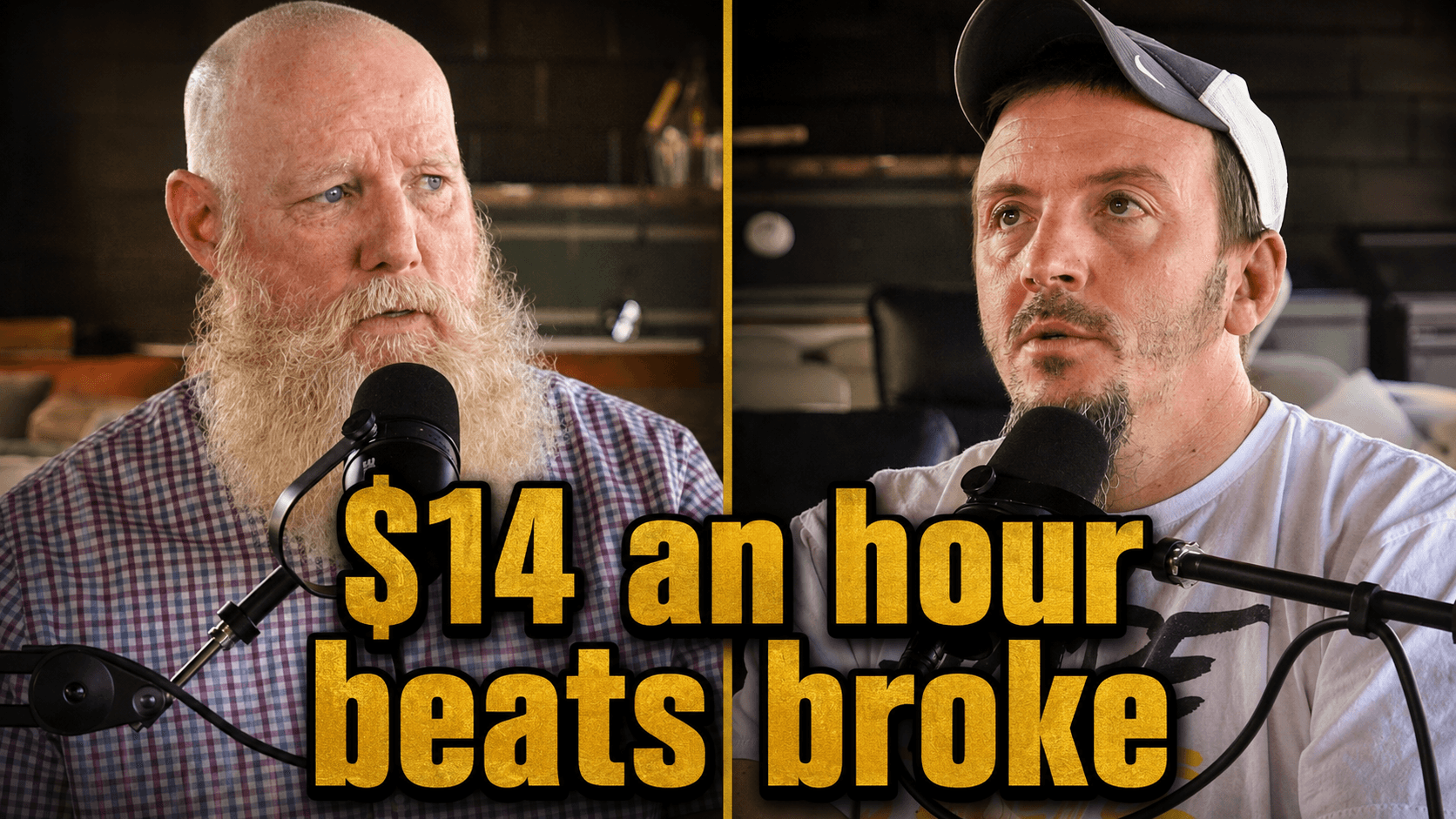
Justin: Welcome back to another episode of Rebuilding Life After Addiction. My name is Justin Franich, and I'm here with my friend Jacob. I wanted to sit down and talk about finances. A lot of guys in recovery, people coming out of active addiction, when they switch from the life they were living to the new life, there's a lot of wreckage. Financial wreckage specifically. I figured it's a good time to chat about that. So why don't you introduce yourself, and then we'll jump in.
Jacob: It's good to be here. I'm Jacob. I'm a business insurance agent with LD&B in Harrisonburg, Virginia. I'm also passionate about helping people get their finances together. Budgeting. The common sense stuff a lot of us weren't taught as kids. Some schools are starting to teach it now. How to budget, how to balance a checkbook. I didn't have that growing up, and when I first got married I realized, there's more going out than coming in. How does that work? So I've done a lot with Dave Ramsey's material. There are a lot of ways to do money. I just think that one's really simple.
Fresh Out of a Program. Where Do I Start?
Justin: Hypothetically, let's say I'm fresh out of a program. I've got a pile of debt, a credit score that's shot, and I'm overwhelmed. I don't know where to start. Where do I start?
Jacob: First of all, it's really good that you recognize everything is a mess. It's hard, because when you look at money you look at your bank account and all the chaos around it. So the first thing is to stop and take a deep breath. You just overcame a huge thing. You overcame an addiction. Whatever that addiction was, it leads to a lot of death. So stop, slow down, breathe.
Then sit down and write out all of your expenses, and figure out all your income. That's a really good first step, because you've got to know what you're working with. Some people are so overwhelmed they think, I can't even look at that. It's stressful, but you have to. That's step one. Give every dollar a name, then figure out what you owe. From there you can step back and ask, how do I find that kind of money?
Justin: It's honesty about how big the mess is. If we don't know how big the mess is, how do we know what kind of cleaning supplies we need to clean it up?
Getting Back on the Grid
Justin: One thing I've noticed is people have this tendency not to grow up into the adult world, not to want to interact with the system. So it's a lot of cash, working under the table. How important is it that we actually get ourselves back into the normal system as a starting point?
Jacob: A huge part of that is just growing up. You do need to get a real job. And then having a bank account is part of it. Most of the world is electronic now. You're going to have a hard time operating, paying your mortgage, your rent, your phone bill, unless you have a bank account and money coming in regularly.
Justin: Dave Ramsey gets a lot of flak on social media, especially from younger generations, for being antiquated. Society has changed since he started. But the thing I love about Dave is it's practical. Here's a step, here's a plan I can follow. So let's go right into that.
Baby Step One: The First $1,000
Justin: I've got my job, I understand the mess, I know all my debts. What do I do from here?
Jacob: I'll speak to this as someone who went through Dave Ramsey's seven baby steps. There are other plans out there, so many I can't wrap my head around them. Dave dumbed it down enough for me. The first thing he says is save $1,000. That's a really low number on purpose. People call his show all the time saying, shouldn't I have more than that? Listen, this is step one. Put $1,000 in the bank and separate it from your everyday expenses.
The Debt Snowball
Jacob: Once you've got that thousand aside, you start attacking your debt. This is the part I love most, the debt snowball. You look at all your debts and the total of each, and you find the one with the lowest amount. Interest rates don't matter. There's a strategy behind it, because what we're doing is behavior modification.
You pay off the smallest debt first. Then you take the amount you were paying on that one and roll it into the next one. Minimum payments on everything else, all your focus on the smallest. It creates a snowball, and it rolls and rolls. Once you get that going, it's hard to stop.
What If I Can't Cover My Minimums?
Justin: How do I walk through it if I don't have enough coming in to pay my minimums when I first get home? I've got a lower-level job, something that's not covering everything. The debt companies are relentless. As guys get back on the grid, the phones and letters start blowing up. What do I do?
Jacob: A couple of things. One is what Dave calls getting gazelle intense. When a lion chases a gazelle, the lion is chasing lunch, but the gazelle is running for its life. That's gazelle intensity. You pour yourself into this, because you're getting yourself out of a mess you got into. Yes, you're forgiven, you're covered, but you still have to deal with the consequences of that old life.
The other thing is reaching out to each debt. Medical is a good example. A lot of medical bills, as long as you're making some kind of payment, they'll work with you. The laws may have changed, so verify that. But when we had a bunch of medical debt with three kids, we were able to pay just a little, and as long as we were paying, they didn't send it to collections. A lot of times you can negotiate the numbers down.
Justin: Being in a recovery program isn't what it was ten years ago, when people looked at you like the pariah of the earth. Recovery is more mainstream now. There's importance in being willing to be transparent. When you call people and say, hey, I just got out of rehab, I'm trying to get things back together, being honest about that is extremely important.
Jacob: It is. And part of gazelle intensity means maybe 40 hours isn't enough. You might work one job 40 hours and another 20. You're getting yourself out of this mess. We've seen a lot of people do it. And sometimes God comes alongside, especially if you're submitting to Him, if He's part of your recovery and you start tithing. I've seen God multiply and do amazing things with money. You have to be intense. You may have to sacrifice. But remember, it's just for a season. You overcame an addiction. You did the hard stuff. Now it's time for more hard stuff, but not quite as hard as what you've already done.
The Emergency Fund
Justin: First I'm putting $1,000 away, squaring up my budget, understanding what's coming in and going out, and starting to pay my debts off. What am I doing next?
Jacob: Once you're debt free, pause and realize what you've done. You overcame an addiction, and now you're debt free. You're crushing it. A majority of Americans have debt, and we're not just talking mortgages, we're talking hundreds of thousands in credit card debt. So that's worth celebrating. Then the next baby step is to save 3 to 6 months of expenses. That could be $10,000, that could be $60,000, depending on where you are and what you're comfortable with. That's money you can access in an emergency.
My grandmother always talked about having an emergency credit card. A credit card is not an emergency fund. Using a credit card for an emergency is like throwing flames on a fire. You're going to make it worse. The borrower is slave to the lender. If you've got 3 to 6 months of cash in the bank, you operate a lot differently than if you're leaning on a credit card.
Justin: Where I've tried to get slick and find a shortcut, maybe it worked once or twice, but the beauty of this plan is the simplicity. It's straightforward. Almost like recovery. It's the daily disciplines that make the difference, whether in discipleship or in finances.
Retirement and the Paid-Off House
Justin: After I've saved up money, what do I do next?
Jacob: The baby steps say to put 15% of your income toward retirement. Nobody knows what social security will look like. I used to think it'd be gone. I'm not sure now, but you should plan like it won't be there. Start an IRA or some kind of savings plan. There are good financial advisors out there, happy to recommend some.
It's also worth considering whether you own a house, because that's a huge strategy. When you retire and you're no longer working, you have a paid-off house. All you're paying then is taxes and insurance. That's a really low cost of living. So put 15% into retirement and let the market work for you. The sooner you start, the more it compounds in your favor.
Justin: Why should I wait until my debts are paid off to start that? I've already wasted so much time.
Jacob: Because 15% is the minimum they recommend. We're taking a step back to get aggressive about paying down those debts. You hear about people paying the minimum and the number never moves. It's costing you so much. The reason you pay off all your debt first is to free up that regular income so you can invest it and still take care of yourself. You're still paying for the four walls, food, clothing, utilities, and shelter, the basics. You pay for those the whole time, but you cut costs everywhere else so you can attack the debt. Then you put 15% of your annual income into retirement, and you start considering, is now the time to buy a house? That's a huge asset, and it should be part of your plan.
Here's something a little challenging. You need good credit to get a mortgage, no question. But do you need good credit to get a house? No. Because maybe you paid down $300,000 in five years. I wonder if you could save $600,000 in five or six years now that everything else is paid off, and pay cash for a house. It depends on your strategy and your appetite. I have a mortgage, so I'm not saying you shouldn't. It's whatever works for you and your family. But man, if I could pay cash for a house, I'd do it in a heartbeat.
Staying Motivated Through the Grind
Justin: This whole process, getting dug out, the emergency fund, the debt paid off, before you even feel like you're thinking about the future. How do people stay motivated? It can be a long road. You might really hustle and get it done in a year or two depending on how deep the hole is. But it can feel like you're grinding and not seeing the light at the end of the tunnel.
Jacob: A couple of things. There are great financial coaches out there. I do a little of that for friends and family. But for me, what always helped, and I never actually reached out to a coach, was remembering the first time I sat down to a budget. I remember the chaos of it. Growing up, I couldn't wait to learn about interest rates and credit cards. Then I look back and realize we were not good with money growing up. There's a level of helplessness that comes with that. So the motivator, for me and for a lot of people, is, I'm never going back to that.
Even Dave Ramsey was a big debt guy. He invested a lot on debt, and the reason he speaks against it so strongly is he got burned. He lost everything, had to go home to his family and say, we're going bankrupt, we have to sell it all and rebuild. That feeling of helplessness, of not knowing what you're going to do, that's a good motivator. I'm never going to let that happen again. And you're walking alongside God through it. Don't count yourself out just because you had an addiction. People have done crazier things. There are doctors who didn't start training until later in life.
The Gifts You Already Have
Justin: That gazelle-intense mode. I remember when Ashley and I were working on our stuff early on. I started reselling things, thrift shopping and selling on eBay, then video editing on the side, skills I didn't have before. You go get a job that pays the bills, but then you start thinking about other ways to earn income. I love that the church has shifted toward kingdom entrepreneurship. It wasn't really a thing back in the day. The church was mostly, let's get you squared away to go to a third-world country, not a lot of business development or helping people see their entrepreneurial gifts. As you dig yourself out, you may start to realize gifts in you, and you start trying things on the side. That side hustle could become the main dish down the road.
Ministry in the Marketplace
Jacob: There's a really good book called The Monk and the Merchant that touches on this. A lot of people come out of addiction and go straight into ministry because they feel like they have to stay close to God. But there's something to be said for this. Sometimes God calls us to ministry in the pulpit, and sometimes God calls us to ministry in the marketplace.
In the book, there's a kid who loves God with all his heart, and he goes to a monk and asks, what must I do? The monk takes him to a beautiful cathedral and introduces him to a man there. The kid asks, why are you introducing me to him? The monk says, you said you want to be close to God. This cathedral we're sitting in, this old, beautiful place, was built because this man went out and funded the entire thing. So there's power in being called to ministry in the marketplace just as much as the pulpit. You won't be seen as much. But that's okay. We're in the kingdom. God sees everything we do.
Justin: Even in business, it's ministry. Like the fivefold giftings, God calls us to solve a problem in the world. The problem I've been called to solve as a minister is helping people with addiction. That's my purpose. And it shows up. Today I'm selling couches to make that happen. It's the same with business. God calls you to solve a problem for people. The more problems you solve, the more needs you meet, the more successful you are. The theology gets mixed up sometimes, but we're only successful in business or ministry when we serve people. There's an exchange. They give us money for serving them well. And really, it's a service unto God, no matter what it is.
Jacob: So what you're saying is, Chick-fil-A is God's chicken.
Justin: It is. And it's funny, that was my first job after Teen Challenge, after I went straight into working for the ministry. Honestly, part of me was a little scared to step out and do anything else. That area felt like protection. The other part of me thought, if I'm going to be all in for God, I need to suffer and sacrifice. And it works, don't get me wrong. But we learned some things down the road.
The Last Step: Build Wealth and Give
Justin: So the last baby step. What is it? When I reach the pinnacle, am I finished?
Jacob: The last step is the one I can't wait to get to. Build wealth and give. At this point you're completely out of debt. You're paying everything you have to pay, covering the four walls, and you've probably got some nice things. You get to decide where your money goes. But the bigger thing, the reason I'm excited about it, is that it's time to build wealth and give. The give part gets me really excited. I want to have something to leave behind for my kids.
I've been the recipient of huge blessings, both as a married man with my family and as a kid. Deep down I think, I want to be on the other end of that. I want to be able to bless people when I see a need, because I've been in the situation where, oh my gosh, we might get kicked out of our house because we don't have rent for next month. I remember that vividly.
His Mom, the Offering Plate, and the Rent Money
Jacob: When I was in sixth or seventh grade, my parents split up and divorced. Neither of them were in church when I was little. Around 8 or 9 they split, got back together, and we all started going to church. It was a dramatic shift, and it was real. I remember the impact Jesus had on my family. A couple of years later they decided it wasn't working, and they divorced. We stayed with my mom in the same house, though we'd only been there about a year because we moved a lot.
My mom started getting serious about her faith and was getting baptized. It was Cornerstone Church in Broadway, back in '98 or '99. She told me she felt like God was calling her to put her entire paycheck, which happened to be the exact amount of our rent due the following week, into the offering plate. And she did. Then she got up and gave a testimony about it. I remember hearing her heart, how real it was. That was when I really grew up. My parents had split, and I realized it was on me to take care of myself emotionally, spiritually, to decide whether I was going to follow God. And I did.
She gave that testimony, and I remember thinking it was like the story of the penniless widow who put her last two cents in the offering. Jesus said that was a huge blessing. People were cheering. After the service, a whole bunch of people came up to my mom, congratulating her on being baptized and handing her money. Then one of the pastors pulled her aside and said, look, we've got a lot of people here who want to help you. You're a single mom with three kids. And from what I remember, our bills were pretty much paid for six months. The church just paid our bills.
That's part of the reason I'm so passionate about money. Not because I want to be rich and have all the stuff. Because I want to be able to give. I want to be able to be a blessing. That's what's waiting on the other side of all this. You got yourself out of an addiction, out of the mess. It's worth it in the end, because you get to the point where you see other people struggling with what you struggled with, and you get to be a blessing to them.
Teaching the Next Generation
Justin: Things happen in our lives that shift how we see the world going forward. I've thought a lot about that with my kids. From 17 to 22, even when I got clean, I didn't take money seriously. I figured, let me go all in on ministry and God will provide. And He did. But now I get to teach Chloe. Do what you're supposed to do with this. Save money, treat it right. She's 17 with the wherewithal of a 30-year-old. The conversation is just different. Do this well now, and when you're 21 you'll have the freedom to do what you want. Go to college, start a business, because you're making the choices now.
How to Reach Jacob
Justin: As we wrap up, Jacob, you do some financial coaching, but your main focus right now is business insurance. Give people a shout out, tell them how to find you. You'll be tagged in the post on Facebook, and I'll put your info in the description and comments on YouTube.
Jacob: LinkedIn is the best place to find me. I get to serve the community through business insurance. I do a bit of everything, property and casualty, liability, car, home. But I really focus on the business side. Business owners have a unique set of risks to manage. So I meet with them, learn about their business, and make sure they're fully covered. I do a lot with churches, sober living homes, and nonprofits. That's my favorite. My background is actually more in schools, so I'm still connecting all of it. It's been fun meeting pastors, learning how they serve their communities, learning about sober living. I didn't realize how different the strategies are for helping people in that arena. We're doing really well with it.
Justin: For my friends in the recovery space, if you run a recovery program, sober living, or discipleship program, Jacob was able to get us insured and save us money. I'd encourage you to reach out to him.
And for those of you watching, jump in the conversation. What's one thing that's worked for you when it comes to money? Are you a Dave Ramsey fan? Do you follow the debt snowball and the baby steps to a T, or are you Dave Ramsey modified with a little something extra thrown in? Or do you have a completely different strategy? Drop it in the comments and let us know.
Thank you, Jacob, for sitting down. And thank you all for watching and joining along. Please like and subscribe. We'll see you again soon. God bless.