Field Notes
What Is Cychlorphine? The New Opioid 10x Stronger Than Fentanyl
Justin Franich
April 1, 2026 · 10 min read
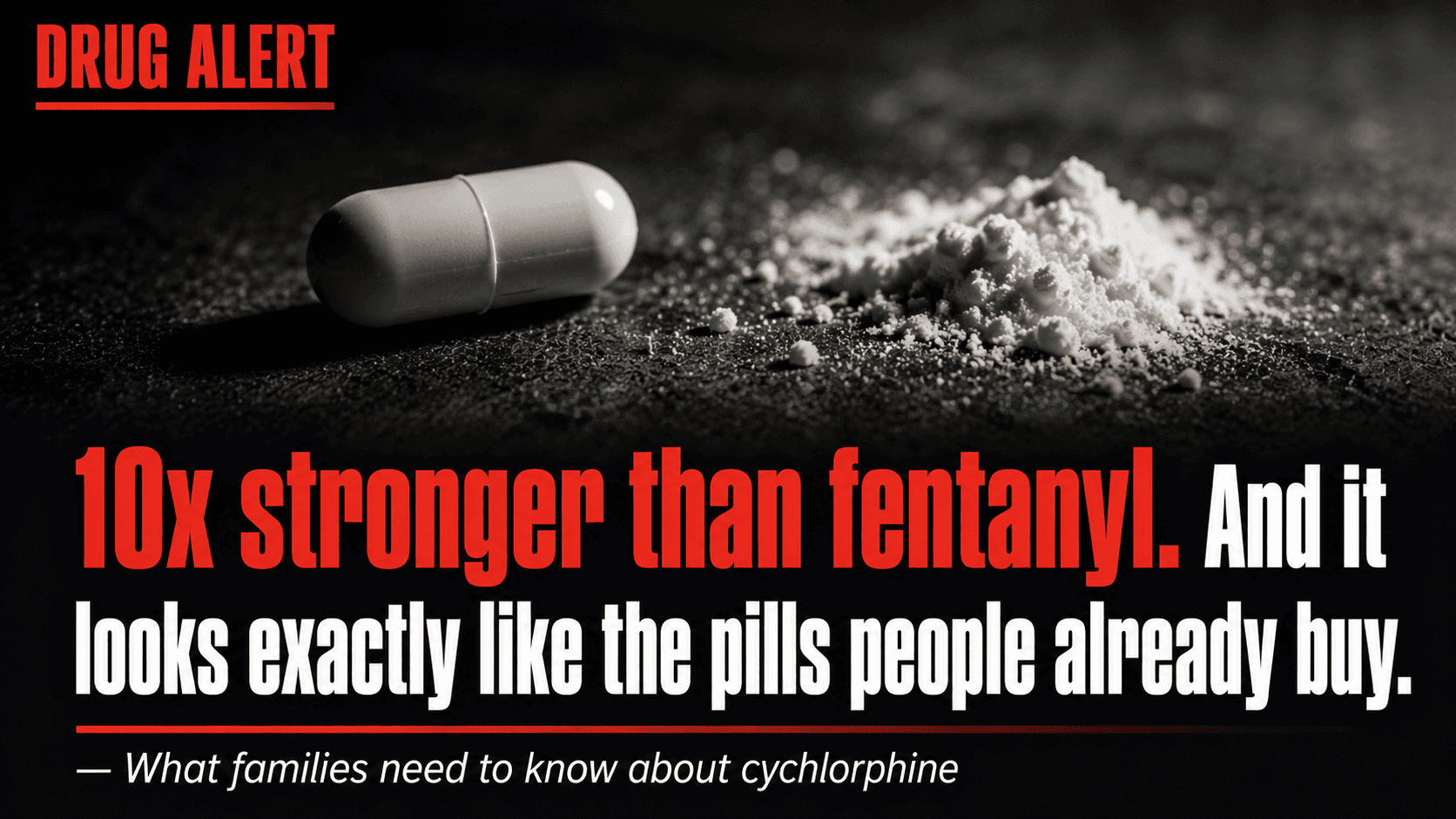
There is a drug killing people who don't even know they're taking it.
It's called cychlorphine, a synthetic opioid estimated to be ten times stronger than fentanyl. It doesn't look different or smell different. It shows up in the same pills, the same powder, the same bags people have been buying for years. And the test strips that were supposed to catch fentanyl can't detect it.
Since October 2025, cychlorphine has been linked to at least 19 deaths in East Tennessee alone, with confirmed detections in at least nine states and reports emerging from more than twenty. The people who died from it had no idea it was in what they took.
If you love someone who uses, if you're in recovery yourself, or if you pastor a church or lead a ministry in a community where addiction is present, this is something you need to understand.
What Is Cychlorphine?
Cychlorphine, also called N-Propionitrile chlorphine, is a novel synthetic opioid. "Novel" means it's structurally different from fentanyl, even though it acts on the same receptors in the brain. It was first identified by researchers in 2024. It appeared in five European countries before making its way into the U.S. drug supply.
Here's what makes it so dangerous.
It is roughly ten times more potent than fentanyl. In at least one confirmed fatal case, the amount found in the person's blood was approximately 0.5 nanograms, which is one-billionth of a gram. A dose so small it's invisible to the naked eye.
It has never been approved for human use anywhere in the world, and in most states it hasn't been formally scheduled yet, which creates legal gray areas that slow down prosecution.
The part that should concern every family is this: standard fentanyl test strips do not detect it, and neither do most hospital toxicology screens. Specialized testing is required, and most emergency rooms don't have it. That means someone can overdose on cychlorphine and the doctors treating them may not even know what they're dealing with.
If you've been following the fentanyl crisis, cychlorphine is the next chapter of that story. We wrote about fentanyl and recovery when that wave was hitting hardest. This is what comes after.
We've also written about medetomidine, the new sedative now appearing in Virginia's fentanyl supply.
Where It's Showing Up
Cychlorphine isn't being sold as cychlorphine. That's part of the problem. It's being mixed into heroin, counterfeit pills, and methamphetamine. Most of the confirmed deaths involve cychlorphine combined with other substances. People buying what they think is their usual supply are getting something radically more dangerous without knowing it.
As of early 2026, here's what the map looks like:
Tennessee has been hit hardest. Knox County and Roane County reported the first confirmed deaths in October 2025, and that number has climbed to at least 19. Kentucky has confirmed detections in Fayette County near Lexington. Ohio has issued overdose alerts in Gallia County. Oklahoma lost an 18-year-old. The DEA confirmed cychlorphine in drug seizures in Chicago. Federal agencies have reported detections in Texas, California, and Missouri. By January 2026, over 100 toxicology specimens had come back positive across nine states and three Canadian provinces.
We're in Virginia's Shenandoah Valley. Tennessee, Kentucky, Ohio, West Virginia are not far-off places. The same supply chains that move drugs through Appalachia move through our communities too.
If someone you love is in addiction and you don't know what to pray anymore, grab our free guide: 5 Prayers for Families Still in the Fight.
No spam. Unsubscribe anytime.
Does Narcan Still Work?
Yes. This matters, so let me be clear about it.
Naloxone, the medication in Narcan, still works against cychlorphine. It binds to the same opioid receptors. The drug doesn't bypass it.
But here's the complication. Because cychlorphine is so potent, you may need multiple doses of Narcan to reverse an overdose. One dose might not be enough. First responders are being told to carry extra and be prepared to administer repeatedly.
Do not let anyone tell you Narcan is useless against this drug. That rumor has already spread online and it's been debunked. Narcan remains life-saving, but with ultra-potent opioids, more doses and faster response times are required. If you have a loved one who uses, carry Narcan and learn how to use it. Understand that you may need to give it more than once while waiting for help to arrive.
Why This Matters for Your Family
If you're reading this, there's a decent chance you're not reading it out of casual curiosity. You're reading it because someone you love is using. Or someone you love is in recovery and you're afraid of what's out there.
I want to speak directly to you for a minute.
The drug supply has changed. What your loved one was using a year ago is not necessarily what they're getting now. A pill that looked the same, from the same source, bought the same way, can carry something entirely different inside it. And the tools we had to catch it weren't built for this.
That doesn't mean there's no hope. But it does mean the urgency just went up.
If you've been watching someone you love continue to use and telling yourself they'll be okay because they've managed this long, that math doesn't hold the way it used to. The margin for error has gotten a lot thinner.
If you're not sure whether your loved one is using, we have a guide that walks through the signs of drug abuse without the clinical jargon. And if you're past the guessing stage and you know something is wrong but you don't know what to do next, read how to tell if your loved one needs a program. It's written for exactly the spot you're in.
If someone you love is struggling with addiction, don't wait for the next headline. Get help today.
Hear more on the Rebuilding Life podcast: Helping a Loved One Through Addiction — Watch This First
What the Church and Recovery Community Needs to Understand
This is the part that most news coverage doesn't touch, and it's worth sitting with for a minute.
Cychlorphine is not just a public health issue. It's a pastoral issue and a discipleship issue. It's the reality that someone in your congregation could be one pill away from a substance they've never heard of.
Think about the person sitting three rows back on Sunday who's been quietly using prescription pills they buy from a friend, or the kid in your youth group who tried something at a party, or the guy in your men's group whose son just relapsed. Any one of them could encounter this drug without ever choosing to take it.
Recovery programs need to understand this too. If you run a faith-based program or a ministry that serves people in addiction, the landscape has shifted. The drugs coming through the door with your next intake are not the same drugs that came through two years ago. Your team needs to know what cychlorphine is. Your intake process needs to account for the possibility that someone has been exposed to substances that standard screens won't catch.
I know the tension this creates. The tension between "God protects His people" and "We need to be wise." But Scripture doesn't put those two things at odds.
Proverbs 22:3 says it plainly: "A prudent man foresees evil and hides himself, but the simple pass on and are punished"(NKJV).
This is a wisdom verse, not a fear verse. The prudent see danger and they prepare. They don't pretend it isn't there or spiritualize their way around it. They face it with their eyes open and they take action.
Hosea 4:6 puts it even more directly: "My people are destroyed for lack of knowledge" (NKJV).
The faith response to cychlorphine is not panic, and it's not pretending the problem won't reach your community. The faith response is getting informed, training your people, carrying Narcan, having honest conversations, and making sure every person in your church knows there is a path out of addiction that starts with a phone call.
If you're a pastor or ministry leader thinking about building recovery support into your church, we put together a practical guide on how to start a recovery ministry at your church. And if you want a biblical framework for how to talk about addiction with your congregation, our Bible verses for addiction page is the most comprehensive collection we've built.
What You Can Do Right Now
Knowing about this matters, but only if it leads somewhere. Here are some things you can do today.
Learn what to look for. Most families don't recognize the signs of drug abuse until it's advanced. The earlier you see it, the better the odds.
Carry Narcan and learn how to use it. It's available at most pharmacies without a prescription. It still works against cychlorphine. You may need to give more than one dose. Knowing how to use it could be the difference between life and death for someone you love.
Have the conversation. The old "just say no" talk doesn't cover this. The conversation about laced drugs is different because it's not about willpower. It's about the fact that a single pill from a source someone has used before can now contain something unsurvivable. That's a conversation worth having even if it's uncomfortable.
If your loved one is using, act now. Not next week, not after the holidays, not after they hit rock bottom. The margin for "they'll figure it out on their own" has gotten very thin. Our complete family guide walks you through what to do and what not to do, and if they're ready for help, the get help page is where to start.
Pray, and then act on what you've prayed. Those two things were never meant to be separate. If you're carrying a loved one in prayer, we wrote something specifically for you: Praying for an Addict You Love.
Share this article. The people who most need this information are the ones who haven't heard it yet. The parent who doesn't know this drug exists, the pastor who hasn't briefed his congregation, the friend who's been telling themselves it's not that bad. If this helped you understand the situation better, it might help someone in your life too.
Hear more on the Rebuilding Life podcast: Breaking the Cycle — Mastering Relapse Prevention in Addiction Recovery
This Is Worth Taking Seriously
I'm not writing this to scare you. I'm writing it because I care about the people you care about, and silence doesn't serve any of us well.
Twenty years ago I was the guy taking whatever was handed to me without asking questions. Meth was going to kill me and I didn't care. Jesus got ahold of me through Teen Challenge in 2005, and I haven't gone back. But the drug supply I survived doesn't exist anymore. What's out there now moves faster and hits harder, and the people using it often have no idea what they're actually taking.
The people in your life who are still using need you to take this seriously. Not with judgment or a lecture, but with information and love and an open door.
That's what this article is. An open door.
If someone you love is struggling, reach out to us. We serve men in Virginia's Shenandoah Valley through faith-based recovery and discipleship. We've been doing this since 2000, and we're not going anywhere.
Hear more on the Rebuilding Life podcast: He Couldn't Fix His Meth Addiction — Here's How God Set Him Free
You’re not alone in this
If addiction has someone you love, talk to someone who’s been there.
The conversation is free and confidential. Justin & Rob answer the phone — both in recovery themselves.
One quiet email a week
New articles and podcast episodes when they drop. No pressure, no spam.
Justin Franich
Justin Franich is a former meth addict, Teen Challenge graduate, and pastor who has been clean since 2005. Today he's a husband, father, and Executive Director of Shenandoah Valley Adult Teen Challenge. He hosts the Rebuilding Life After Addiction podcast and helps families across the U.S. navigate faith-based recovery options, compare programs, and rebuild life after addiction.
Read my storyKeep going
Know a family who needs this? Send it to them.
Monthly partners
Articles like this stay free because partners keep them free.
No paywall, no ads — monthly partners cover the writing, the phone line, and the guidance behind every page, so the next family searching at 2 a.m. finds real help.
Become a monthly partner